Baby changing when you're out
Try shopping centres, large shops, stations and airports, and look for the baby changing symbol on the door. Our maps list 4,823 UK toilets and 1,723 toilets in world cities recorded with baby changing. With no table, the NHS says the best place to change a nappy is on a changing mat or towel on the floor.
The short answer
- Look in shopping centres, large shops, stations, airports and family-friendly cafés and museums.
- Check every door: the table may be in the women's, the men's, an all-gender room or a separate baby room.
- With no table, use a mat or towel on the floor. The NHS calls that the best place to change a nappy, because your baby cannot fall.
- On a table, stay with your baby the whole time, with a hand on them.
- Carry a portable changing mat, nappies, wipes, nappy bags and hand gel. Our guide to the best portable changing mats compares mats for the bag.
Where to find a table
Places built for families and for lots of visitors are worth trying first: shopping centres, department stores, supermarkets, stations, airports, museums and the larger chain restaurants. In a shop or café, ask staff: a table may be in a staff area or a separate baby room.
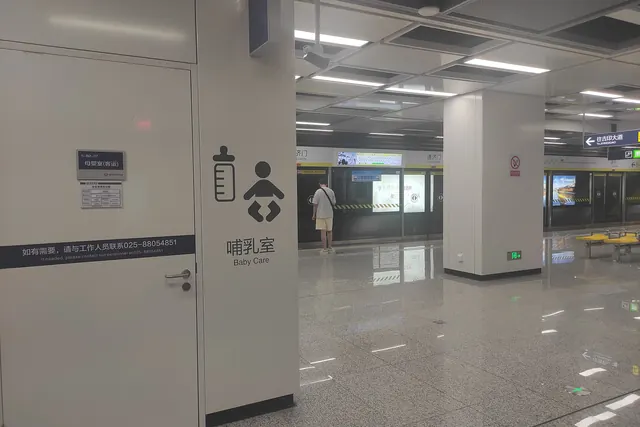
Look for the baby changing symbol on the door or the direction signs. In Japan, the Japan Sanitary Equipment Industry Association lists separate guide symbols for a diaper (nappy) changing table, for a baby chair fixed inside a toilet, and for facilities for infants, such as rooms for breastfeeding and changing. Japanese multi-function toilets also give priority to people with babies.
On our maps, the baby changing toilets page shows the toilets recorded with a table, in the UK and in our world cities.
Men's, women's and all-gender rooms
A table can be in any of these rooms, and a building may have only one. If you are a father or a carer and the table is in the women's toilets, ask staff whether there is another one, or use an all-gender room.
- In the US, the BABIES Act requires baby changing facilities in restrooms open to the public in buildings run by the General Services Administration. A restroom without one is exempt if a sign shows where a table is on the same floor.
- In England, building regulations guidance says baby changing facilities should not be put in the wheelchair-accessible unisex toilet unless it is the only toilet in the building, and that a fold-down table is worth considering in the larger cubicles of men's and women's toilets.
- All-gender toilets can be used by any parent. Of the 4,736 UK toilets in our council area lists recorded with baby changing, 759 (16%) are also recorded as all-gender. In our world cities, 591 of the 1,723 toilets tagged with a changing table are also tagged unisex. See gender-neutral toilets for the list.
OpenStreetMap can record which room a table is in, with values such as female_toilet, male_toilet, unisex_toilet and wheelchair_toilet. Our city lists do not store that detail yet.
What our data shows
We count a toilet as having baby changing only when its record says so. A toilet whose record says nothing may still have a table: not recorded is not the same as no.
In the UK
The UK figures come from the Great British Public Toilet Map, which marks each toilet as having baby changing, not having it, or leaves it blank. Across the UK we list 4,823 toilets with baby changing. The table counts the 14,775 toilets matched to a council area (1,042 more are not matched to one, so they are not in the nation rows).
| Area | Toilets listed | Baby changing | Share | Recorded as none | Not recorded | Also all-gender |
|---|---|---|---|---|---|---|
| England | 11,826 | 4,024 | 34% | 1,921 | 5,881 | 672 |
| Scotland | 1,690 | 460 | 27% | 242 | 988 | 55 |
| Wales | 840 | 158 | 19% | 129 | 553 | 26 |
| Northern Ireland | 419 | 94 | 22% | 44 | 281 | 6 |
| All four nations | 14,775 | 4,736 | 32% | 2,336 | 7,703 | 759 |
| London | 1,907 | 666 | 35% | 421 | 820 | 209 |
Across the four nations, 7,703 toilets (52%) have nothing recorded either way, so the count is a minimum, not the true number.
In world cities
For 77 cities outside the UK we use OpenStreetMap: every public toilet mapped within 8 km of the city centre, in snapshots taken on 17 November 2026. Of 17,988 toilets, 1,723 (10%) are tagged changing_table=yes and 1,962 (11%) changing_table=no. The other 14,303 (80%) have no usable tag, so we cannot say either way.
| Country | Share |
|---|---|
| Sweden | (108 of 434) |
| Germany | (256 of 1,225) |
| Australia | (266 of 1,325) |
| Poland | (147 of 767) |
| Austria | (151 of 950) |
| Denmark | (74 of 508) |
| Norway | (34 of 265) |
| Switzerland | (98 of 878) |
| Canada | (76 of 741) |
| United Arab Emirates | (10 of 99) |
| New Zealand | (48 of 527) |
| Japan | (141 of 1,827) |
| Belgium | (23 of 284) |
| Netherlands | (12 of 154) |
| United States | (59 of 887) |
| Spain | (23 of 333) |
| Italy | (32 of 581) |
| Brazil | (16 of 267) |
| Portugal | (26 of 637) |
| Singapore | (14 of 347) |
| South Africa | (4 of 104) |
| France | (65 of 1,929) |
| Turkey | (7 of 256) |
| Greece | (5 of 156) |
| China | (17 of 1,200) |
| South Korea | (4 of 591) |
| Thailand | (4 of 332) |
| Mexico | (3 of 219) |
| India | (0 of 165) |
A low share can mean that mappers in that country have not recorded changing tables, not that the toilets lack them.
When there is no table
The NHS says the best place to change a nappy is on a changing mat or towel on the floor: if you need to see to another child for a moment, your baby cannot fall. It suggests doing it sitting down, so that you do not hurt your back.
- Find a clean, dry, quiet spot: a large cubicle, a baby room, a bench, or the back seat of the car with the doors shut.
- Put down a portable mat, or a towel, before your baby.
- Get everything out of the bag before you start, so you never have to take your hand off your baby.
- If you have to use a table, follow the NHS: keep an eye on your baby at all times, do not rely on the straps, and never walk away or turn your back.
- Wash your hands afterwards. The NHS says to do this before you do anything else, to avoid infection.
What to carry
The NHS list of what you need for a nappy change works as a checklist for the bag:
- Clean nappies (and liners and covers if you use cloth nappies).
- Fragrance-free, alcohol-free baby wipes, or cotton wool and water.
- Bags for the dirty nappy and wipes. The NHS says disposable nappies can be rolled up and sealed with their tabs, then put in a bag kept only for nappies.
- Barrier cream, to protect your baby's skin.
- A towel or cloth for drying.
Add for days out:
- A portable changing mat. See the best portable changing mats.
- Hand gel, for toilets with no soap.
- A spare set of clothes, for your baby and a top for you.
- For a toddler in potty training, a folding potty or seat. See the best travel potties.
Older children and adults
A baby changing table is for babies and toddlers. The BABIES Act, for example, defines a baby changing facility as a table or device for changing the nappy of a child aged 3 or under. Older children and adults who need changing need a bigger bench.
That is what a Changing Places toilet is for. England's building regulations guidance describes them as facilities designed for people with complex and multiple impairments who may need help from up to two assistants, and says they should be provided in addition to baby changing facilities. Read what a Changing Places toilet is and how to find one. In Japan, look for the nursing care bed symbol.
Does the law require baby changing?
United States
The Bathrooms Accessible in Every Situation Act (BABIES Act), Public Law 114-235, was signed on 7 October 2016. It requires restrooms in public buildings run by the Public Buildings Service of the General Services Administration to have baby changing facilities that are physically safe, sanitary and appropriate. It does not apply to restrooms not open to the public, to a restroom with clear signs to a changing table on the same floor, where the cost of the building work needed is unfeasible, or to buildings not being altered. It covers federal buildings only; state and city building codes can add their own rules.
England
Building regulations guidance, rather than a rule for every toilet, covers baby changing in England. Approved Document M, Volume 2, says that in large building developments, separate facilities for baby changing are desirable, that a fold-down table is worth considering in enlarged cubicles, and that wheelchair-accessible unisex toilets should not be used for baby changing. Approved Document T, which took effect on 1 October 2024 for new buildings in England other than homes, says that in certain developments separate baby changing facilities should be provided, not inside the toilets it describes.
The European Union and elsewhere
We did not find an EU-wide law that requires baby changing in public toilets. If you know of a national rule we should add, tell us.
Common questions
Where can I change my baby when there is no changing table?
The NHS says the best place to change a nappy is on a changing mat or towel on the floor, because your baby cannot fall from there. Kneel or sit beside your baby, keep everything you need within reach, and wash your hands afterwards.
Are there baby changing tables in men's toilets?
Sometimes. In US federal buildings run by the General Services Administration, the BABIES Act of 2016 requires restrooms open to the public to have baby changing facilities, with some exceptions. Elsewhere it depends on the building, so try an all-gender or family room, or ask staff.
Is a changing table required by law?
In the US, the BABIES Act requires baby changing facilities in public restrooms in buildings run by the General Services Administration, with exceptions. In England, the building regulations guidance says separate baby changing facilities are desirable in large developments but sets no rule for every toilet. We did not find an EU-wide law.
Is it safe to use a public changing table?
Stay with your baby the whole time. The NHS says to keep an eye on your baby at all times on a changing table, never to walk away or turn your back, and not to rely on the straps to keep your baby secure.