Can a shop refuse to let you use the toilet?
In the UK, a shop, café or pub can usually refuse to let you use its toilet: there is no general legal right to use a business's toilet, even in an emergency. In 20 US states, according to the Crohn's & Colitis Foundation, restroom access laws make shops with an employee toilet let customers with certain medical conditions use it, and workers in the UK, the EU and Australia have a right to toilets at work. The public toilets near you may be closer than you think.
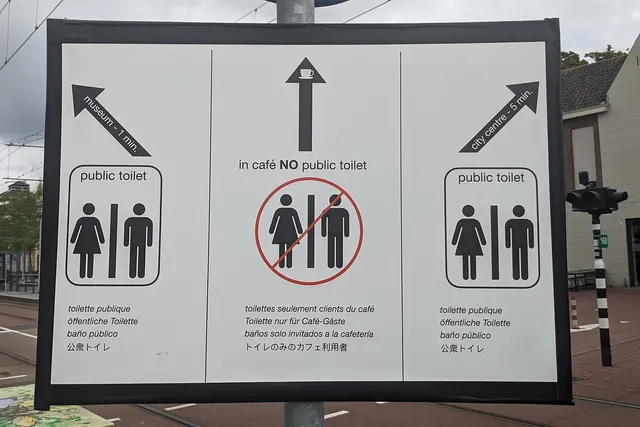
The short answer
- In the UK, no law makes shops, cafés or pubs let passers-by use their toilets, and refusing someone because they are disabled can be unlawful.
- In the United States, restroom access laws in 20 states make shops with an employee restroom let customers with qualifying medical conditions use it, when the law's conditions are met.
- Workers are on firmer ground than customers: UK, EU and Australian workplace rules require toilets for staff.
- A toilet card, or a key for locked accessible toilets, makes it easier to ask, or means you do not have to.
United Kingdom: what the law says
UK law deals with toilets in a few situations, and none of them gives the public a right to walk in off the street:
- For staff. Employers must provide toilets for the people who work for them, under workplace health and safety rules (see At work). Those toilets are for staff.
- For people using some premises. In England and Wales, section 20 of the Local Government (Miscellaneous Provisions) Act 1976 lets councils require places that sell food or drink to be consumed on the premises, places that hold entertainment, exhibitions or sporting events, and betting offices to provide toilets for members of the public who use them.
- Public toilets. Councils in England and Wales have a power, not a duty, to provide public toilets. In Wales, the Public Health (Wales) Act 2017 also makes them publish a local toilets strategy. Read whether councils have to provide public toilets.
When a 2021 petition to Parliament asked for people with inflammatory bowel disease to be given access to toilets, it was rejected on the grounds that access to privately run toilets is a matter for each business.
If you are a customer
If a café or pub has toilets for customers and you are a customer, you can expect to use them. That is the point of them, and in England and Wales the council can require them under the 1976 Act. What counts as a customer is up to the business. Some cafés lock their toilets with a code printed on the receipt; if you need the toilet urgently and cannot wait to order, say so and ask for the code.
Disability and the Equality Act
Under the Equality Act 2010, businesses and other service providers in England, Scotland and Wales must not discriminate against disabled people, and must make reasonable adjustments so that disabled people are not put at a substantial disadvantage. A condition counts as a disability when it has a substantial, long-term effect on your normal daily activities, and a condition such as Crohn's disease or ulcerative colitis can meet that test. In Northern Ireland, the Disability Discrimination Act 1995 applies instead, and service providers there must also make reasonable adjustments. In practice, that can mean:
- A business that lets customers use its toilet should not refuse a disabled customer because of their disability.
- Letting a disabled person use a staff toilet, when the customer toilet is not accessible, may be a reasonable adjustment.
- Keeping an accessible toilet usable, and not filled with stock, may also be part of providing the service.
What is reasonable depends on the circumstances. The law does not require every shop to let every disabled person use a staff toilet. Read about IBS, Crohn's and finding a toilet for more on living with a bowel condition.
Pubs, cafés and restaurants
No single UK law says that every café or restaurant must have a toilet for customers. In England and Wales, a council can serve a notice under section 20 of the 1976 Act requiring a place that sells food or drink to be consumed there to provide toilets for the public who use it, and to keep them clean. If you are a paying customer and a venue has customer toilets, ask to use them. If it refuses because of your disability, that may be discrimination under the Equality Act.
If there is nowhere to go
Urinating in the street can get you fined. Some councils in England and Wales use public spaces protection orders to ban it. In Bromley, for example, the order bans urinating or defecating in public other than in a public toilet, with a £100 fixed penalty notice or a fine of up to £1,000 if the case goes to court. In Scotland, section 47 of the Civic Government (Scotland) Act 1982 makes it an offence to urinate or defecate in a way that causes, or is likely to cause, annoyance to anyone else. If you have a medical condition, carrying a toilet card and a RADAR key, and knowing where the public toilets are, makes it less likely that you will be in that position.
If you are refused
If you think you were refused because of a disability, write down what happened, when and where, and who you spoke to. Then get advice from Citizens Advice or the Equality Advisory and Support Service, which can explain your options, including a complaint to the business. Explaining the problem to the head office may also help the next person.
If a public toilet you rely on has closed or is always locked, tell the council that runs it, through its website or customer services. Our council area pages list all 15,817 UK public toilets we know of, so you can check which ones are still open nearby.
Children and schools
In the UK, nobody has a legal right to use a shop's toilet, and that includes children. But staff may well help a child who needs to go, so it is always worth asking. In schools in England, the School Premises (England) Regulations 2012 require suitable toilets and washing facilities for pupils, and separate toilets for boys and girls aged eight or over unless each toilet is in a room of its own.
United States: restroom access laws
According to the Crohn's & Colitis Foundation, the Restroom Access Act, often called Ally's Law, has been enacted in 20 states. It is named after Ally Bain, who has Crohn's disease. At 14 she was refused the employee-only restroom in a store that had no public one, and she then worked with the Illinois legislature to pass the first law, in 2005.
Where a law applies, a shop that has a restroom for its employees must let a customer with a qualifying medical condition use it when no public restroom is available. The details vary by state. This guide names only the states whose rules we have read on an official state site or the Foundation's own page:
- Minnesota: the customer must have an eligible medical condition or use an ostomy device, shown by a written document from a physician or a qualifying nonprofit; three or more employees must be working; the shop must not normally make a restroom available to the public; a public restroom must not be immediately accessible; and access must not create an obvious health, safety or security risk.
- Maryland: the request must be made during business hours with no public restroom conveniently accessible, and at least three employees on shift. The conditions covered are Crohn's disease, ulcerative colitis or another inflammatory bowel disease, any other condition that needs immediate access to a toilet, and conditions that need an ostomy device. The evidence is a health care provider's signed statement on an identification card issued by the Maryland Department of Health.
- Washington: the state Department of Health lists Crohn's disease, ulcerative colitis or other inflammatory bowel disease, irritable bowel syndrome, any condition requiring an ostomy device, and any permanent or temporary condition requiring immediate access to a restroom. The customer shows a form signed by a health care provider, or an identification card from a nonprofit that serves people with those conditions. The shop does not have to make physical changes and may ask an employee to go with the customer.
- Illinois passed the first law, in 2005.
For any other state, check the state's own code or the Crohn's & Colitis Foundation. The Foundation offers a free "I Can't Wait" card, which it says is often accepted as proof, and a We Can't Wait app for finding restrooms. It also says patients and volunteers have been disappointed by a lack of awareness and compliance, and by the absence of ways to enforce the laws, so a polite request with your card in hand still works best.
At work
Workers are on firmer ground than customers. In the UK, the EU and Australia, the rules require toilets for people at work.
United Kingdom
In Great Britain, the Workplace (Health, Safety and Welfare) Regulations 1992 require employers to provide suitable and sufficient toilets and washing facilities at readily accessible places, kept clean, lit and ventilated, with separate rooms for men and women unless each toilet is in its own room that locks from the inside. Northern Ireland has its own regulations, from 1993, with the same basic duty. The Health and Safety Executive's approved code of practice gives minimum numbers. For a mixed workforce, or for women only:
| People at work | Toilets | Washbasins |
|---|---|---|
| 1 to 5 | 1 | 1 |
| 6 to 25 | 2 | 2 |
| 26 to 50 | 3 | 3 |
| 51 to 75 | 4 | 4 |
| 76 to 100 | 5 | 5 |
For toilets used only by men, the code allows urinals to make up part of the count. If you work away from a fixed site, ask your employer how you can reach a toilet during your work. If your employer does not provide proper toilets, raise it with them first, then with your union or the Health and Safety Executive.
European Union
Council Directive 89/654/EEC sets minimum safety and health requirements for workplaces. For workplaces covered by its Annex I, separate facilities with an adequate number of toilets and washbasins must be provided near workstations, rest rooms, changing rooms and rooms with showers or washbasins, with separate toilets, or separate use of toilets, for men and women.
Australia
In South Australia, SafeWork SA says employers must give workers access to adequate welfare facilities, including clean toilets, and points to the code of practice on managing the work environment and facilities for the details.
Other countries
Elsewhere, this guide covers only what we could check on official or scheme pages: voluntary schemes that open business toilets to the public, and keys for locked accessible toilets.
- Germany, Austria and Switzerland: in more than 400 towns and municipalities that take part in Die Nette Toilette, cafés, restaurants and shops with the sticker let anyone use their toilet free, without buying anything, and the towns support them financially. Read about community toilet schemes.
- Euroschlüssel: a shared lock for accessible toilets, lifts and car park barriers, set up for Germany, Austria and Switzerland, opens accessible toilets at motorway services and stations. In Germany it is for people whose disability card carries certain marks (aG, B, H or BL, or G with a degree of disability of 70) or a degree of disability of 80 or more.
- Australia: the MLAK key opens locked accessible toilets, Changing Places facilities and other dedicated facilities. Buying one is restricted to people with a disability, or with written authority from a doctor, a disability organisation, a community health centre, or the owner or manager of a building with an accessible toilet. The government's National Public Toilet Map shows where public toilets are.
- United Kingdom: the RADAR key opens locked accessible toilets, and some councils run community toilet schemes.
How to ask
- Go to the counter rather than heading straight for the toilet.
- Be brief and polite: “I'm sorry, I need a toilet urgently. Could I use yours?”
- If you have a toilet card, show it at the same time: a Can't Wait card in the UK, or the Crohn's & Colitis Foundation's card in the US.
- Offer to buy something if it is a café or pub.
- If they say no, ask where the nearest public toilet is. Staff may know.
Large shops, supermarkets, hotels, libraries and fast-food restaurants are good places to ask. Where there is a community toilet scheme, member businesses let the public use their toilets without buying anything; look for the sticker in the window or on the door.
Common myths
“Pubs have to let anyone use the toilet”
Not true in the UK. A pub can choose who it serves and who uses its facilities, within the law on discrimination. Some will let you in if you ask, but they do not have to.
“A pregnant woman can use a policeman's helmet”
A British myth with no basis in law. Pregnant women have no special legal right to use a business's toilet in the UK, although staff may help.
“A toilet card gives you a legal right”
Not in the UK. A Can't Wait card explains your need and staff may help when they see it, but it does not create a legal right. In US states with a restroom access law, a card can be the evidence the law asks for: Washington accepts an identification card from a nonprofit, and Minnesota a written document from a qualifying nonprofit. The right comes from the law, and only when its other conditions are met.
If you run a business
In the UK, some councils run a community toilet scheme and pay businesses, or help with the running costs, to let the public use their toilets. Ask your council whether it has one. In Germany, Austria and Switzerland, Die Nette Toilette does not take businesses one by one: the town has to register, so ask your town hall. In the US, check whether your state has a restroom access law and what it asks of you.
If you cannot open your toilet to everyone, train staff to respond kindly to toilet cards and to point people to the nearest public toilet. Keep any accessible toilet clear of stock and its alarm cord hanging free.
Common questions
Can a shop refuse to let me use its toilet?
In the UK, yes. A shop, café or pub does not have to let the public use its toilet, and it can say no to customers too, but in England, Scotland and Wales it must not discriminate against you because of a protected characteristic such as disability. In US states with a restroom access law, a shop with an employee restroom must let a customer with a qualifying medical condition use it, if the law's conditions are met.
What is Ally's Law?
It is the popular name for the Restroom Access Act, first passed in Illinois in 2005. According to the Crohn's & Colitis Foundation, 20 US states have passed one. Where it applies, a shop with an employee restroom must let a customer with a qualifying condition, such as Crohn's disease, use it when no public restroom is available. Conditions vary by state: in Minnesota and Maryland, for example, at least three employees must be working.
Does my employer have to provide a toilet?
In the UK, yes: employers in Great Britain must provide suitable and sufficient toilets and washing facilities at readily accessible places, and Northern Ireland's 1993 regulations set the same basic duty. An EU directive requires an adequate number of toilets and washbasins near workstations. In South Australia, SafeWork SA says employers must give workers access to clean toilets.
Is it illegal to urinate in public in the UK?
It can be. Some councils in England and Wales ban it in public places through public spaces protection orders. Bromley's order, for example, bans urinating or defecating in public other than in a public toilet, with a £100 fixed penalty or a fine of up to £1,000 on conviction. In Scotland it is an offence under section 47 of the Civic Government (Scotland) Act 1982 if it causes, or is likely to cause, annoyance.
Do pregnant women have a legal right to use any toilet?
Not in the UK. This is a myth: pregnant women have no special legal right to use a business's toilet there, although staff may help if asked.