Paying for public toilets around the world
Whether you pay depends on the country and on who runs the toilet. In the UK, most public toilets are free, and where you do pay, the usual charge is 20p, counted from our UK data. You pay at Sanifair toilets on German motorways, in some of the largest French railway stations and at Rome's Termini station, while Japan's tourism organisation describes free public washrooms in its stations; to avoid paying anywhere, look for free public toilets near you.
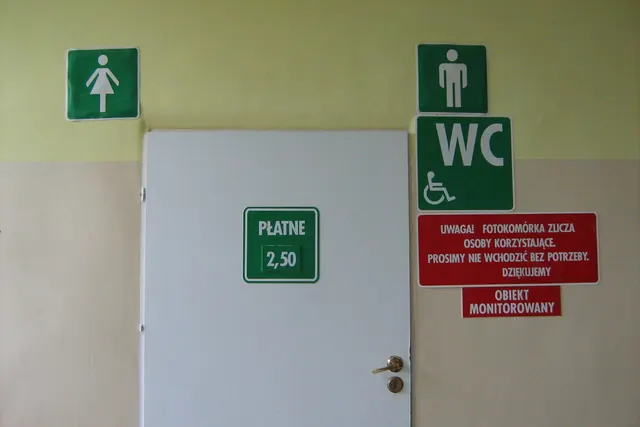
The short answer
- Whether you pay depends on the country and on who runs the toilet, so carry small coins in the local currency.
- In the UK, 12,256 of 15,817 public toilets in our data are free (77%). Where the price is recorded, the most common charge is 20p.
- In Germany, Sanifair toilets at motorway services, and at some stations and shopping centres, charge and give you a voucher back.
- In France, most station toilets are free, but thirty of the largest stations charged €1 in 2023.
- In Japan, only 7 of the 1,827 toilets in our city snapshots are tagged as paid.
- In the United States, only 3 of the 887 toilets in our city snapshots are tagged as paid.
- In India, Sulabh International runs pay-and-use public toilets.
Where you pay, country by country
Our country pages count the toilets mapped in OpenStreetMap around the cities we hold. Mappers can tag each toilet as free or paid. This table shows the share tagged as paid, which gives a rough idea of where you are most likely to pay:
| Country | Cities | Tagged paid | Tagged free | Toilets mapped | Share paid |
|---|---|---|---|---|---|
| Germany | 3 | 323 | 663 | 1,225 | 26% |
| Belgium | 2 | 54 | 155 | 284 | 19% |
| Italy | 3 | 107 | 194 | 581 | 18% |
| Netherlands | 1 | 25 | 77 | 154 | 16% |
| Austria | 3 | 144 | 536 | 950 | 15% |
| Switzerland | 3 | 120 | 495 | 878 | 14% |
| India | 1 | 17 | 19 | 165 | 10% |
| France | 3 | 67 | 1,389 | 1,929 | 3% |
| Australia | 3 | 6 | 793 | 1,325 | 0% |
| Japan | 3 | 7 | 584 | 1,827 | 0% |
| United States | 6 | 3 | 247 | 887 | 0% |
Toilets with no fee recorded are counted as neither paid nor free, so the real share that charges may be higher. Toilets for customers only are mapped too, and they may expect you to buy something.
Germany
Sanifair runs paid toilets at service areas and fuel stations on German motorways, and also in some railway stations, shopping centres and city centres. When you pay, you get a voucher, the Wert-Bon, which you can redeem with participating partners. A voucher from a motorway site is redeemed at participating motorway service areas and fuel stations, not at places off the motorway such as stations or shopping centres. In its announcements of new sites in city centres, stations and shopping centres, Sanifair gives the fee as one euro and the voucher as 50 or 70 cents.
France
In a written answer to the French parliament on 4 July 2023, the government said SNCF Gares & Connexions offered free access at nearly 80% of its station toilets. Thirty of the largest stations were different: their toilets were run by a company under a contract until 2026, with staff and a €1 entry charge. It said SNCF planned to make them free for ticket holders when that contract ended. Check the station's own page before you travel. See public toilets in France.
Italy
At Roma Termini, the rail network's station page lists the toilets on level 1 and level −1, with paid access at 1 euro. See public toilets in Italy for the cities we map.
Switzerland and Austria
The canton of Basel-Stadt says there are more than 93 public toilets in the city of Basel, and that they are free to use. In Switzerland, Austria and Germany, a Nette Toilette sticker on a café or shop door means you can use its toilet free, without buying anything. See Switzerland and Austria, and read about community toilet schemes.
Japan
The Japan National Tourism Organization describes free-to-use public washrooms in Japan's train stations and other venues. In our snapshots of 3 Japanese cities, 7 of 1,827 mapped toilets are tagged as paid. Read using toilets in Japan.
India
Sulabh International introduced pay-and-use public toilets in India in 1974, and its website lists more than 10,700 public toilet complexes. Carry small notes and coins. Read using toilets in India.
United States
In our snapshots of 6 US cities, only 3 of 887 mapped toilets are tagged as paid. The harder problem is finding a toilet at all: the Crohn's & Colitis Foundation calls the lack of publicly available restrooms in the US a serious public health crisis. See public toilets in the United States.
Cities with the most paid toilets
In our OpenStreetMap snapshots, these cities have the highest share of toilets tagged as paid:
| City | Country | Tagged paid | Toilets mapped | Share |
|---|---|---|---|---|
| Krakow | Poland | 77 | 215 | 36% |
| Hamburg | Germany | 79 | 239 | 33% |
| Istanbul | Turkey | 63 | 196 | 32% |
| Berlin | Germany | 190 | 629 | 30% |
| Gothenburg | Sweden | 26 | 101 | 26% |
| Rio de Janeiro | Brazil | 26 | 104 | 25% |
| Stockholm | Sweden | 61 | 255 | 24% |
| Brussels | Belgium | 44 | 184 | 24% |
| Zurich | Switzerland | 99 | 432 | 23% |
| Mexico City | Mexico | 28 | 123 | 23% |
United Kingdom: what public toilets charge
Our UK figures come from council data collected by The Great British Public Toilet Map. 12,256 of 15,817 UK public toilets in our data are free, and 3,427 charge. Where the price is recorded, the most common charge is 20p, the middle value is 20p, and 95% of recorded charges are 50p or less.
The price is recorded for 499 of the 3,427 paid toilets in our data. The chart shows how often each charge appears. Prices are recorded by members of the public and councils and can be out of date, so check the sign on the door.
| Charge | Toilets |
|---|---|
| 20p | |
| 50p | |
| 30p | |
| 40p | |
| 10p | |
| £1 | |
| 60p | |
| 80p | |
| £1.50 | |
| 79p |
Charges above £1 are rare in our data. For 134 toilets, the data does not say whether there is a charge at all. The large railway stations run by Network Rail have been free since 1 April 2019, and in England, motorway service areas must have free toilets.
Where in the UK you pay most often
This is the share of public toilets in our data that charge, in each UK nation:
| Nation | Charge |
|---|---|
| England | (2,505 of 11,826) |
| Scotland | (283 of 1,690) |
| Wales | (188 of 840) |
| Northern Ireland | (72 of 419) |
These council areas have the highest share of paid toilets, among areas with at least 20 toilets in our data. Our data does not record why a toilet charges.
| Council area | Paid | All toilets | Share | Recorded charges |
|---|---|---|---|---|
| Telford and Wrekin | 33 | 56 | 59% | not recorded |
| Halton | 14 | 24 | 58% | not recorded |
| Waltham Forest | 35 | 60 | 58% | not recorded |
| Stockton-on-Tees | 18 | 31 | 58% | not recorded |
| Oldham | 29 | 50 | 58% | not recorded |
| Causeway Coast and Glens | 34 | 60 | 57% | 20p, 10p |
| Portsmouth | 39 | 71 | 55% | not recorded |
| Rhondda Cynon Taf | 24 | 44 | 55% | 20p |
| Tandridge | 24 | 44 | 55% | not recorded |
| Scottish Borders | 32 | 59 | 54% | 30p, 20p |
| Crawley | 32 | 60 | 53% | 10p, 20p |
| Ashford | 19 | 36 | 53% | not recorded |
Why some UK toilets charge
Councils in England have a power to provide public toilets, not a duty, and the same section of the Public Health Act 1936 lets them charge for using them. In Wales, the Public Health (Wales) Act 2017 also lets councils charge. Cleaning, water, repairs and staff all cost money, and each council decides whether to charge.
Costs have fallen in one respect: under the Non-Domestic Rating (Public Lavatories) Act 2021, properties used wholly or mainly as public toilets in England and Wales pay no business rates, for financial years from April 2020. Read whether councils have to provide public toilets for the wider picture.
How you pay
- Coins in a slot on the door or a turnstile. In the UK, keep 20p and 50p pieces; abroad, small coins in the local currency.
- Contactless card or phone readers. The notes in our UK data mention them at some toilets, and Sanifair's new site in Bochum takes cash, Girocard, credit cards and phones.
- An attendant, at some staffed toilets.
- A voucher system, such as Sanifair's in Germany, which gives part of the fee back as a voucher to spend.
In the UK, if the accessible cubicle in a paid block uses a RADAR key instead of a coin slot, key holders may be able to use it without paying.
Ways to avoid paying
- Find free public toilets near you, or use the Free button on any UK council area page.
- Try libraries, museums, shopping centres and supermarkets; in the UK, the large stations Network Rail runs.
- Look for a community toilet sticker in shop, café and pub windows: in some UK council areas, and in towns in Germany, Austria and Switzerland that take part in Die Nette Toilette, member businesses let you use their toilet without buying anything.
- In England, motorway service areas must have free toilets.
Paid toilets and disabled people
Where a paid toilet block also has an accessible toilet, it may use a key lock instead of a coin slot or card reader. In the UK, that is the RADAR lock, so people with a key may be able to use it without paying. In Germany, Sanifair says the accessible toilet at its Bochum city-centre site is free with the Euroschlüssel. Coin slots and turnstiles can also be hard to use from a wheelchair.
If a toilet's only accessible cubicle is hard to get into, tell whoever runs it. In England, Scotland and Wales, the Equality Act 2010 says service providers must not discriminate against disabled people and must make reasonable adjustments.
A little history
The Science Museum Group credits George Jennings with designing and installing the first public toilets, at the Great Exhibition in Hyde Park in 1851. The law that lets councils in England charge for their toilets today is section 87 of the Public Health Act 1936. In India, Sulabh International's founder, Dr Bindeshwar Pathak, introduced pay-and-use public toilets in 1974.
Is it fair to charge?
There are arguments both ways. A charge brings in money towards cleaning and repairs: in France, the government said the €1 entry at the largest stations pays for the toilets to be cleaned after each visit. But a charge costs most for people with little money, for families with children and for people with medical conditions who need the toilet more often.
Some operators have moved away from charging. Network Rail stopped charging at the large UK stations it runs in 2019, and in 2023 the French government said SNCF planned to make the toilets in its largest stations free for ticket holders. Where you can choose, our pages show both free and paid toilets, so you can decide for yourself.
Common questions
Do you have to pay to use public toilets?
It depends on the country and on who runs the toilet. Most public toilets in the UK are free. You pay at Sanifair toilets on German motorways, and at the staffed toilets in thirty of the largest French railway stations. The Japan National Tourism Organization describes free-to-use public washrooms in Japan's train stations. Carry small coins in the local currency just in case.
How much does a public toilet cost in the UK?
Most UK public toilets are free. Where there is a charge, the most common amounts in our data are 20p and 50p, and very few cost more than £1. Our price chart shows how often each recorded charge appears.
What is the Sanifair Wert-Bon?
It is the voucher you get when you pay at a Sanifair toilet in Germany. You redeem it with participating partners: at participating motorway service areas and fuel stations for a motorway voucher, or at shops and restaurants nearby at Sanifair's city sites. In its announcements of new city-centre, station and shopping-centre sites, Sanifair gives the fee as one euro and the voucher as 50 or 70 cents.
Are railway station toilets free?
Often, but not everywhere. In the UK, the 20 large stations run by Network Rail have been free since 1 April 2019. In France, the government said in 2023 that nearly 80% of SNCF station toilets were free, but thirty of the largest stations charged €1. Rome's Termini station lists a 1 euro charge.
Do disabled people have to pay to use paid toilets?
It depends on the toilet. In the UK, where an accessible toilet uses a RADAR lock instead of a coin slot, key holders may not have to pay. At Sanifair's site in Bochum, Germany, the accessible toilet is free with the Euroschlüssel.