What is a RADAR key?
A RADAR key is the key of the National Key Scheme: one standard key that opens locked accessible toilets across the UK. You buy it once, and people who need it because of a disability or health condition can buy it without VAT. We list 2,413 RADAR key toilets in the UK, area by area; other countries use other keys.
The short answer
- It is a standard key that fits the same lock on thousands of accessible toilets in the UK.
- It is for people who need those toilets because of a disability or a health condition.
- You do not have to prove you are disabled to buy one; the Disability Rights UK shop asks only for a declaration.
- Buy the official key from the Disability Rights UK shop, or ask your council; eligible buyers pay no VAT.
- It does not work in Europe, where other keys are used. Visitors to the UK can order one before they travel.
Why accessible toilets are locked
Some councils and venues keep their accessible toilets locked, so that they are free for the people who need them. The National Key Scheme fits these toilets with one standard lock, so a single key opens all of them. Disability Rights UK describes the scheme as giving disabled people independent access to locked public toilets: nobody has to find a member of staff or a council officer to unlock the door.
Locking has a cost: someone who does not have a key, or who is visiting from abroad, can be shut out. If you are caught without yours, ask the staff at the venue whether they keep a key you can borrow.
Where the key came from
According to the Science Museum Group, which holds a RADAR key in its collection, the first RADAR lock was installed in 1981 by RADAR, the Royal Association of Disability and Rehabilitation, which is why the key is still called a RADAR key. Genuine keys are made by Nicholls and Clarke, and today Disability Rights UK sells the official key.
The idea was simple: rather than every council and venue choosing its own lock, they would all fit the same one, so a single key would work everywhere. Estimates of how many toilets it opens range from more than 9,000 (the Science Museum Group and Sheffield City Council) to more than 10,000 (Kirklees Council).
Who can use a RADAR key
Disability Rights UK sells the key to people who need the toilets because of a disability or a health condition. Not every disability or condition is visible. You do not have to show proof to buy a key from its shop: buying it without VAT counts as your declaration that you are eligible.
Anyone can buy a key, but the toilets are meant for the people who need them. If you can use a standard toilet, leave the accessible one free.
Where to buy an official key
- The Disability Rights UK online shop, which shows the current price and describes its key as the official, genuine one.
- Some councils: Sheffield City Council, for example, takes orders online and in person. Check your council's website.
- Some mobility shops: Kirklees Council lists one in Huddersfield.
Genuine keys are made by Nicholls and Clarke. Disability Rights UK tells buyers not to accept a substitute, so be wary of cheap keys from general marketplaces. Its shop sells the key VAT-free to individuals who are eligible for VAT relief and are buying it for their own use; organisations such as care homes must pay VAT. Councils and other sellers set their own prices.
A RADAR key is large, often with a coloured handle so it is easy to spot. Most people keep it on their house keys, so it is with them whenever they go out.
Visiting the UK
If you are coming to the UK and need accessible toilets, you can buy the official key from the Disability Rights UK shop before you travel. Its country list shows only the United Kingdom, Guernsey, the Isle of Man and Jersey, and its delivery policy says physical orders arrive within 10 working days, so allow time and use a delivery address there. Some councils also sell keys in person, as Sheffield City Council does. If you arrive without one, ask the staff at the venue whether they keep a key you can borrow.
Using a RADAR toilet
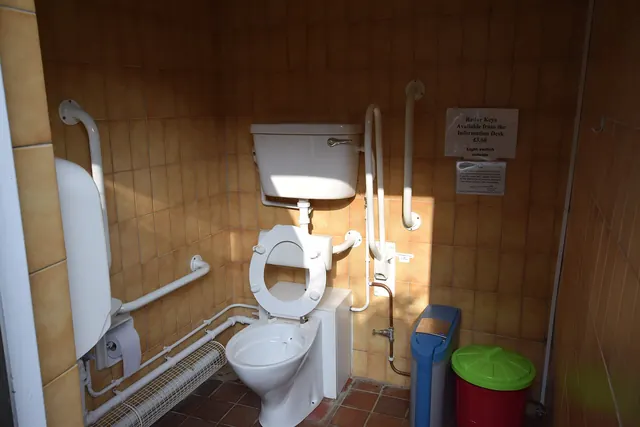
A RADAR toilet is usually a single, unisex room with grab rails and space to turn a wheelchair. Some have a baby changing table. A RADAR toilet is not the same as a Changing Places toilet, which is larger and has a hoist and an adult changing bench, although some Changing Places toilets also use a RADAR lock.
- Look for the RADAR lock: a round keyhole, often with a small symbol or sticker on the door.
- Turn the key to open, then lock the door from the inside with the bolt or lever.
- When you leave, close the door properly behind you so the toilet is secure for the next key holder.
- If something is broken, tell the council or venue: look for a phone number or reference on the door.
On our council area pages, every toilet with a RADAR lock is marked, and the RADAR key button shows only those toilets. Combine it with Open now to see which ones you can use straight away.
Where RADAR toilets are
You will find RADAR locks on council toilets and in places such as shopping centres, pubs and train stations that have joined the scheme. In our data, 2,413 UK public toilets use the lock, which is 15% of all the toilets we list. Northern Ireland has the highest share.
| Nation | Share |
|---|---|
| England | (2,030 of 11,826) |
| Scotland | (153 of 1,690) |
| Wales | (90 of 840) |
| Northern Ireland | (101 of 419) |
The council areas with the most RADAR toilets are Causeway Coast and Glens (40), East Riding of Yorkshire (37), North Norfolk (37), North Tyneside (37) and East Suffolk (34). Our figure is lower than the scheme's own because not every council or venue has recorded which of its toilets use the lock.
| Council area | RADAR key toilets |
|---|---|
| Causeway Coast and Glens | of 60 |
| North Norfolk | of 75 |
| East Riding of Yorkshire | of 66 |
| North Tyneside | of 61 |
| East Suffolk | of 70 |
| Northumberland | of 100 |
| Bristol | of 204 |
| Wiltshire | of 117 |
| Dorset | of 147 |
| Westminster | of 136 |
When the key doesn't work
- The key turns but the door won't open. Push the door gently while turning; some locks are stiff.
- The key won't go in. It may be a copy, or the lock may be damaged. Try another toilet and report it.
- The toilet is out of order. Use the area page to find the nearest other RADAR toilet.
- The toilet is used as a store room. Tell the venue; an accessible toilet only works if it is clear.
Outside the UK
A RADAR key is for the UK's National Key Scheme, and Kirklees Council notes that it does not work in Europe. Other countries have their own keys: the Euroschlüssel (Euro key) was set up by a disability organisation in Darmstadt as a shared system for Germany, Austria and Switzerland, and in Australia many councils use the MLAK key. Each has its own rules on who can get one. Our guide to the RADAR key and the Euro key compares the schemes in detail. For toilets in cities abroad, see wheelchair accessible toilets.
Is a RADAR key worth it?
If you need an accessible toilet often, almost certainly. A key is a one-off purchase. Without one, a locked accessible toilet means finding a member of staff, a council officer or a neighbouring business to open it, which takes time you may not have. With one, you can use any RADAR toilet as soon as you reach it, including at times when nobody is around to help, such as early in the morning or on a Sunday.
It is also worth having if you only need an accessible toilet now and then, for example during a flare-up of a bowel condition or while recovering from an operation. Many people buy a key for a relative and keep it in the car. If you rarely go far from home and the toilets near you are unlocked, a key matters less; check the area page for your town to see how many toilets there use the lock.
Lost or broken keys
A lost key is simply replaced: buy another from the same sellers. A key that is bent or worn may not turn properly; replace it rather than forcing it, because a snapped key blocks the lock for everyone.
If a lock itself is broken, the council or venue that runs the toilet needs to know. Look for a phone number or reference on the door, or contact the council through its website. Reporting it helps the next person.
Common questions
How much does a RADAR key cost?
The price depends on where you buy it. The Disability Rights UK online shop shows its current price, and people buying a key for their own use because of a disability or health condition can buy it without VAT by declaring that they are eligible. Some councils sell keys too, at their own prices.
Do I need proof of disability to buy a RADAR key?
Not from the Disability Rights UK shop. Its product page asks for no documents: buying the key without VAT counts as your declaration that you are eligible for VAT relief and that the key is for your own personal use.
Can I buy a RADAR key on Amazon or eBay?
You can find keys there, but they may not be genuine. Disability Rights UK describes the key in its shop as the official and only genuine one and tells buyers not to accept a substitute. Genuine keys are made by Nicholls and Clarke.
Will a RADAR key work outside the UK?
Not in Europe: Kirklees Council notes that RADAR keys do not work there. Other countries have their own schemes. The Euroschlüssel (Euro key) was set up as a shared system for Germany, Austria and Switzerland, and Australia has the MLAK key. Each has its own rules on who can get one.
Can I get a RADAR key if I am visiting the UK?
Yes, but plan ahead. The Disability Rights UK shop's country list shows only the United Kingdom, Guernsey, the Isle of Man and Jersey, and its delivery policy says physical orders arrive within 10 working days. Some councils, such as Sheffield City Council, also take orders in person.