How to find a toilet fast, wherever you are
The fastest way to find a toilet, in any country, is to let your phone do the looking: open the public toilet map, allow your location, and walk to the nearest one that is open. With no signal, head for a large station, shopping centre, fast-food restaurant, library or fuel station. What works best differs from country to country, so this guide adds notes for Japan, Germany, France, the US, India, Australia and the UK.
Right now: three steps
- Open the map and allow your location. The map centres on you and shows the toilets around you.
- Tap the nearest marker to see its opening hours, whether it is free and whether it is accessible, where that is recorded.
- Choose Directions to walk there in your phone's maps app.
Your location is used in your browser to centre the map; it is not stored. If you would rather not share it, type a town, postcode or street into the search box on the public toilets near you page instead.
Using our map and filters
Our toilets come from two places. In the UK, they come from The Great British Public Toilet Map, and every council area has its own page listing all its public toilets, with a map beside the list. Elsewhere, our country and city pages list the toilets mapped in OpenStreetMap around each city. On a UK area page, the buttons above the list narrow it down:
- Open now compares each toilet's opening hours with the time on your phone and hides the ones that are shut.
- Free hides toilets that charge.
- Wheelchair accessible, RADAR key, Baby changing and Gender-neutral keep only toilets with that facility recorded.
- Open 24 hours keeps only toilets that never close.
Opening hours are recorded for 6,793 of the 15,817 UK toilets we list (43%). For the rest, Open now cannot tell, so the status is shown as unknown. If you are relying on a toilet with unknown hours, have a second one in mind.
Places to try anywhere
When you cannot check a map, these kinds of place are good bets in most countries. Opening hours and house rules vary, so have a second choice in mind.
Railway and bus stations
Large stations often have toilets, and some charge. In the UK, Network Rail runs 20 of the largest stations, and it stopped charging for the toilets at the last of them on 1 April 2019. More than 2,500 other UK stations are run by train companies: check a station's facilities, including toilets, on its National Rail Enquiries page. In France, most station toilets are free, but some of the largest stations charge; our guide to paying for public toilets has the details.
Shopping centres and large supermarkets
Many have customer toilets. Look near the entrance, the café or the customer service desk, or ask at the tills.
Fast-food restaurants and cafés
Customers can usually use the toilet, and if you are not buying anything you can still ask. Some toilets open with a code printed on the receipt. In some places a sticker on the door shows that a business lets anyone use its toilet: read about community toilet schemes.
Libraries, museums and galleries
Many have a toilet for visitors. Check the opening hours first, as they vary from day to day.
Fuel stations and motorway services
Large fuel stations and service areas on main roads often have toilets, and some open late or all night. See On the road, below.
Public toilets run by the council or city
In parks, on seafronts, in town-centre car parks and at bus stations. In the UK, these are what our area pages list first, and some close at dusk, so read the notes on the area page.
Hotels
Large hotels often have toilets near the lobby or restaurant. Ask at reception.
Apps and maps
- Our public toilet map uses your location to show the nearest toilets, from UK council data and OpenStreetMap.
- OpenStreetMap is the open map behind our pages outside the UK. Anyone can add a toilet to it, with its opening hours, charge and accessibility.
- Google Maps: in India, Google added more than 57,000 public toilets in over 2,300 cities to Google Maps in 2019, working with the Swachh Bharat Mission of the Ministry of Housing and Urban Affairs. Google suggested searching for "public toilets near me".
- Australia: the Australian Government's National Public Toilet Map, part of the National Continence Program, can show only toilets that are open now or open 24 hours.
- Germany, Austria and Switzerland: the free Nette Toilette app shows the nearest café, restaurant or shop that lets anyone use its toilet.
- United States: the Crohn's & Colitis Foundation's free We Can't Wait app helps people find restrooms they can use, and lets users and businesses add places.
In a town or city centre
Head for the main shopping street, where a shopping centre, a department store, a large supermarket or the library may be close by. If the council or city runs public toilets, look by the main car park, the bus station or the market square, or check our city or area page. If there is a community toilet scheme, its website or app may list the businesses that take part.
On the road
Service areas on motorways and main roads are good places to stop. In England, motorway service areas must have free toilets that are open 24 hours a day, all year, including a toilet for disabled people and a Changing Places toilet. On German motorways, look for Sanifair toilets at service areas and fuel stations: you pay to go in, and get a voucher, the Wert-Bon, that you can redeem at participating sites. Our guide to paying for public toilets explains how it works.
On other main roads, try large fuel stations and supermarkets. Lay-bys may have no toilet, and some toilets at picnic sites close for the winter. Plan stops before you set off on a long journey, especially with children.
In the countryside
Toilets can be far apart in rural areas, and some close for the winter or at dusk. Try visitor centres, car parks at popular walks, beaches and village halls. In the UK, check the council area page before you go: the map shows how far apart the toilets are, and the notes say when a toilet closes for the season.
Late at night and on Sundays
After dark, look first for toilets that are open all night, then hospitals with an emergency department, airports, motorway services and large fuel stations. In our UK data, only 1,131 public toilets are recorded as open 24 hours. On Sundays, large shops in England and Wales may open for only six hours, between 10am and 6pm. Read which public toilets open on Sundays for the UK figures, and see public toilets open 24 hours for where they are.
Country by country
Stations, shopping centres and museums are worth trying in most countries, and some toilets charge, so carry small coins in the local currency. These notes add what our sources say about particular countries. Our country pages map the public toilets in the cities we hold, from OpenStreetMap:
| Country | Cities | Toilets mapped |
|---|---|---|
| Japan | Tokyo, Kyoto and Osaka | 1,827 |
| Germany | Berlin, Munich and Hamburg | 1,225 |
| Austria | Vienna, Graz and Linz | 950 |
| Switzerland | Zurich, Basel and Geneva | 878 |
| France | Paris, Lyon and Marseille | 1,929 |
| Italy | Milan, Rome and Naples | 581 |
| United States | New York City, San Francisco, Seattle, Chicago, Los Angeles and Miami | 887 |
| India | Mumbai | 165 |
| Australia | Sydney, Melbourne and Brisbane | 1,325 |
That is the toilets mapped, not every toilet there is. For the UK, our UK page covers every council area.
Japan
The Japan Sanitary Equipment Industry Association lists airports, stations, places to stay, convenience stores, commercial facilities and parks among the places to find a toilet, and notes toilets on Shinkansen trains and long-distance buses. The Japan National Tourism Organization describes free-to-use public washrooms in train stations and other venues, with the route to them often marked by yellow tactile paving. Read using toilets in Japan before you go, and see public toilets in Japan.
Germany, Austria and Switzerland
On German motorways, look for Sanifair toilets at service areas and fuel stations: you pay, and get a voucher back. Sanifair also runs toilets in some stations, shopping centres and city centres. In towns, a Nette Toilette sticker on the door of a café, restaurant or shop means you can use its toilet free, without buying anything. The network says more than 400 towns and municipalities in Germany, Austria and Switzerland take part. See public toilets in Germany, Austria and Switzerland.
France and Italy
In a written answer to the French parliament in July 2023, the government said SNCF Gares & Connexions offered free access at nearly 80% of its station toilets, while thirty of the largest stations had staffed toilets with a €1 entry charge. In Italy, the rail network's page for Roma Termini lists a 1 euro charge for its toilets. See public toilets in France and Italy.
United States
According to the Crohn's & Colitis Foundation, 20 states have passed a Restroom Access Act, often called Ally's Law; the first was Illinois, in 2005. Where it applies, a shop with an employee restroom must let a customer with a qualifying medical condition use it when no public restroom is available, under conditions that vary by state. Read your right to use a toilet for the details, and see public toilets in the United States.
India
Sulabh International introduced pay-and-use public toilets in India in 1974, and its website lists more than 10,700 public toilet complexes; its 2019 site counts 36 railway stations among the places they are. Carry small notes and coins. Read using toilets in India and see public toilets in India.
Australia
Use the government's National Public Toilet Map, described under Apps and maps. Locked accessible toilets there may use the MLAK key (see below). See public toilets in Australia.
United Kingdom
Our UK data lists 15,817 public toilets, with a page for every council area. Network Rail's large stations and motorway service areas in England have free toilets, as described above; some councils also run community toilet schemes.
Reading the signs
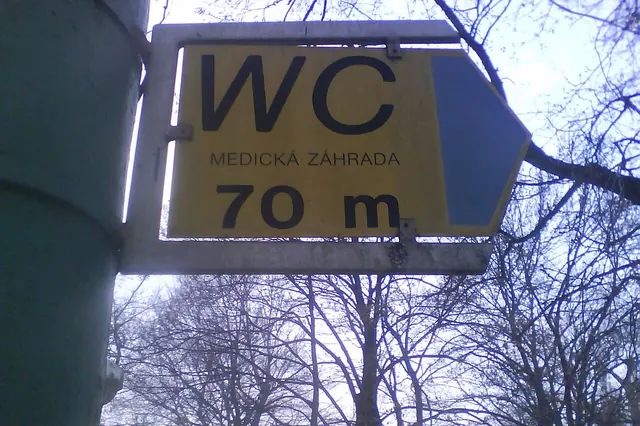
Toilet signs differ between countries. WC stands for water closet, an older name for a flushing toilet, and you may see it on signs at home and abroad. Our guide to the word for toilet in other languages lists what to look for on doors and how to ask.
In stations, shopping centres and airports, look for the toilet on the same hanging signs that point to platforms, gates or exits rather than on a wall. The wheelchair symbol marks an accessible toilet, a baby on a changing table marks baby changing, and a Changing Places toilet may have its own sign. In the UK, public toilets may be signed "Toilets", "Public toilets" or "WC"; some town-centre finger posts point to toilets, and brown tourist signs on roads sometimes show a toilet symbol. In parks, try near the café, the playground or the main car park if you cannot see a sign.
You may also meet a squat toilet rather than a seat. Read how to use a squat toilet if you have not used one before.
If you have particular needs
- Wheelchair users: on a UK area page, use the Wheelchair accessible button. Some countries lock accessible toilets with a key: the RADAR key in the UK, the Euroschlüssel, a shared lock system set up for Germany, Austria and Switzerland, and the MLAK in Australia. Each has its own rules on who can buy one.
- Bladder and bowel conditions: a Can't Wait card helps you ask staff for a toilet when there is no public one. Read about IBS, Crohn's and finding a toilet.
- Parents: the Baby changing button shows toilets with a changing table; large shops are a good fallback.
- People who need a hoist or a changing bench: in the UK, check the official Changing Places map before you travel. Read what a Changing Places toilet is.
Out with children
Young children give very little warning, so it pays to know where the nearest toilet is before anyone asks. A few habits help:
- Ask everyone to try before you leave the house, the car or the café, even if they say they do not need to.
- Note the toilets on the way into a park, beach or shopping centre, not just at the far end.
- For toddlers, a travel potty or a fold-up seat for an adult toilet saves a lot of stress.
- Use the Baby changing filter on our map, or read the guide to baby changing toilets, which explains where tables usually are and why some are only in the women's toilets.
- An accessible toilet has room for a buggy and an adult with a child, but leave it free for disabled people when you can.
When you really cannot wait
If you have no time to search, go to the nearest large building that is likely to have a toilet and is open: a supermarket, a café, a pub, a library, a hotel lobby or a fuel station. Ask the first member of staff you see, say it is urgent, and be polite. If you have a medical condition, a Can't Wait card explains your need without words, and in the UK a RADAR key opens locked accessible toilets without asking anyone.
In the UK you have no general legal right to use a shop's toilet, but staff can choose to let you, and in some US states the law gives customers with certain medical conditions a right to use an employee restroom. Our guide to your rights to use a toilet explains what the law says and how to ask.
Before a day out
- Open our page for the city or council area you are visiting and look at the toilets near where you will spend most time.
- Check opening hours, especially on a Sunday or late in the day; some toilets also close for the winter.
- Note whether you need to pay, and carry coins or a contactless card for a paid toilet.
- If you need an accessible toilet, check whether it is locked with a key, and take yours.
- Note one back-up for each stop: a supermarket, station or large café.
Help the map
Our UK data comes from The Great British Public Toilet Map, where anyone can add, edit or remove toilets, and which also asks councils and other organisations for information. Our world data comes from OpenStreetMap, which anyone can edit. If a toilet on the map has closed, changed its hours or started charging, correct it on the Toilet Map or on OpenStreetMap. The next update carries the fix to everyone who uses the map after you.
Common questions
How do I find the nearest public toilet?
Open our map and allow it to use your location. It shows the public toilets around you, nearest first, with directions. With no signal, head for a large station, shopping centre, fast-food restaurant, library or fuel station.
Can I use a shop or café toilet without buying anything?
It depends on the country and the business. In the UK there is no general right to, but staff can choose to let you, and some councils run community toilet schemes. In Germany, Austria and Switzerland, a Nette Toilette sticker means you can use the toilet free without buying anything. In 20 US states, according to the Crohn's & Colitis Foundation, restroom access laws let customers with certain medical conditions use a shop's employee toilet, under conditions.
Are public toilets free?
Many are, but not everywhere. In our UK data, 12,256 public toilets are recorded as free and 3,427 as charging. The Japan National Tourism Organization describes free-to-use public washrooms in Japan's train stations. At Sanifair toilets on German motorways you pay, and get a voucher back.
Where can I find a toilet late at night?
Try large railway stations, 24-hour supermarkets, fuel stations, hospitals and fast-food restaurants that open late. In our UK data, 1,131 public toilets are recorded as open 24 hours, and our 24-hour toilets page lists the areas that have them.
Why are some toilets not on the map?
Our UK data comes from The Great British Public Toilet Map, which collects information from the public, councils and other organisations, and our world data comes from OpenStreetMap. If nobody has added a toilet to either, it will be missing. Anyone can add or correct toilets on both.