How to use a squat toilet
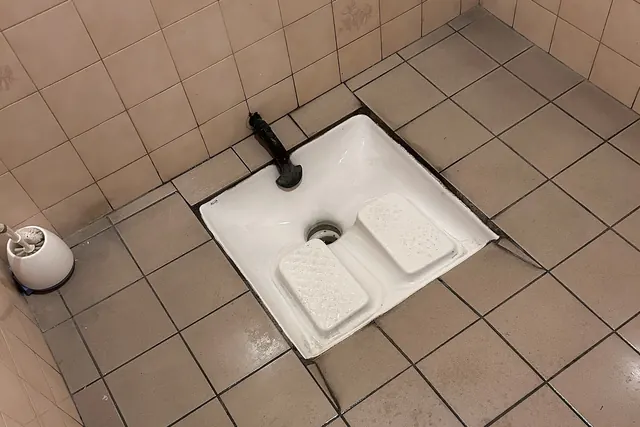
Stand with a foot on each side of the opening, lower yourself into a deep squat with your feet flat, and keep your clothes clear of the floor. Flush with the lever, button or pedal, or pour water from the bucket if there is no flush. If you cannot squat, look for a seated or accessible toilet.
The short answer
- A squat toilet is a pan set into or on the floor. You squat over it instead of sitting.
- Put a foot on each side of the opening, feet flat, and squat as low as is comfortable.
- Roll up long trousers, and hold skirts and coats clear of the floor.
- Flush with whatever is there: a lever, a button, a pedal, a pull chain, or water from a bucket.
- Follow the local rule on paper: in the bowl in Japan, in the bin where a sign asks for it.
What a squat toilet is
Wiktionary defines a squat toilet as a toilet that is used while squatting instead of sitting; it lists Turkish toilet as another name. The pan sits at floor level, with the opening between your feet.
- In Japan it is a Japanese-style toilet, 和式 (washiki, Japanese style). The Japan Sanitary Equipment Industry Association describes it as a toilet that has been used in Japan since olden days, used by squatting over it.
- In India it is sold as an Indian WC. The maker CERA lists other names, including Indian toilet, squatting pan, Orissa pan and Indian commode, and describes the Anglo-Indian Orissa pan as a traditional squatting pan common in Indian homes and public toilets. Sulabh International's two-pit pour-flush toilet has a squatting pan set with its rim flush with the floor, and footrests.
- Western-style means a seated toilet: 洋式 (yōshiki) in Japanese.
Step by step
- Get ready before you go in. Take tissues and hand gel out of your bag, and roll up long trousers.
- Hang your bag up on the door hook, or wear it on your front. Do not put it on the floor.
- Find your footing. Stand with a foot on each side of the opening, on the footrests if the pan has them. Which way to face depends on the pan and the cubicle: if there is a diagram on the wall, follow it.
- Lower your clothes to your knees, gathering them in front so that nothing trails on the floor or into the pan.
- Squat slowly, feet flat, until your hips are low over the opening. Hold the door handle or a grab rail if there is one.
- Clean up with paper or water, then stand up slowly before you dress.
- Flush, then wash your hands with soap, or use hand gel if there is no soap.
Flushing
Flushes vary as much as on seated toilets. In Japan, the Japan Sanitary Equipment Industry Association lists a lever on the tank, a lever you press down, a button on the wall, a sensor you hold your hand over and a button on a remote, and says some of the newest toilets flush when you stand up. Elsewhere you may also find a foot pedal or a pull chain.
If there is no flush but there is a tap with a bucket or jug, it is a pour-flush toilet: pour water into the pan until it is clear. Sulabh International says its pour-flush design needs only 1.5 to 2 litres of water a time, against 10 to 12 litres for a cistern flush, so you do not need much.
Paper, water and the bin
In Japan, the Japan Sanitary Equipment Industry Association says to leave toilet paper in the bowl and flush it, to flush only toilet paper and other flushable paper, and to put sanitary towels and tampons in the bin beside the toilet. It also suggests carrying flushable tissue, because some toilets run out of paper.
Elsewhere, look for a sign. If it asks you not to flush paper, put used paper in the bin. You may find a tap, a jug or a hand spray for washing, and you can use water, paper or both. If you would like to carry your own water, our guide to the best travel bidets compares portable bottles. For what actually spreads germs in a public toilet, see toilet hygiene.
Clothes, bags and balance
- Trousers: roll the hems up before you start, so they stay off a wet floor.
- Skirts, dresses and long coats: gather them up in front of you and hold them there.
- Pockets: zip or button them. A phone that falls out of a back pocket can end up in the pan.
- Bags: use the hook on the door, or wear the bag on your front.
- Balance: keep your feet flat and a little wider than your hips. If your heels lift, hold the door handle or a rail, and lower yourself only as far as is comfortable.
If you cannot squat
If squatting is hard for you, for example because of your knees, hips or balance, you have other options:
- Look for a seated toilet. In Japan, the Japan Sanitary Equipment Industry Association says Western-style toilets are now the most common type and that Japanese-style toilets are being converted. Door signs there use separate symbols for squat and seated toilets, so you can check before you go in.
- Use an accessible toilet. Japanese multi-function toilets are roomier, with priority for wheelchair users, people with an ostomy and people with babies.
- Try hotels, airports and shopping centres, and ask whether they have a seated toilet.
- Stand rather than squat. A female urination device lets women pass urine standing up, so there is no need to squat. Our guide to the best female urination devices compares them.
- With young children, a squat pan can be hard to balance over. A travel potty gives them somewhere to sit.
Where you will meet them
We only name countries where we found a source:
- Japan. Japanese-style toilets may be installed as public toilets, although Western-style toilets are now the most common. See using toilets in Japan.
- India. The maker CERA describes its Anglo-Indian Orissa pan as common in Indian homes and public toilets. See using toilets in India.
On OpenStreetMap, mappers can record whether a toilet is seated, squat or a urinal with the toilets:position tag. Our city lists do not store that tag yet, so our maps cannot tell you which toilets are squat toilets. To read the door signs abroad, see what to call a toilet abroad.
Common questions
Which way do you face on a squat toilet?
It depends on the pan and the cubicle, and we have not found an official source that settles it for every design. If there is a diagram on the wall, follow it. Otherwise, stand with a foot on each side of the opening, so that you squat over it rather than in front of or behind it.
Can I flush toilet paper down a squat toilet?
In Japan, yes: the Japan Sanitary Equipment Industry Association says to leave toilet paper in the bowl and flush it, and to put sanitary products in the bin. Elsewhere, if a sign asks you not to flush paper, put it in the bin provided.
What if I cannot squat?
Look for a Western-style (seated) or accessible toilet. In Japan, Western-style toilets are now the most common type, and multi-function toilets give priority to wheelchair users, people with an ostomy and people with babies.
Why is it called a Turkish toilet?
Turkish toilet is another name for a squat toilet in English. In Japan the same kind of toilet is called washiki (Japanese style), and in India it is sold as an Indian WC or Orissa pan.