What is a Changing Places toilet?
A Changing Places toilet is a large accessible toilet for people who cannot use a standard one, with a ceiling hoist, a height-adjustable adult-sized changing bench and room for carers. The UK, Ireland, Australia and New Zealand each have a national scheme that lists its toilets; in the US, ask for a universal or adult changing table. Many people who use wheelchair accessible toilets manage with a standard accessible room; many people with profound and multiple learning disabilities, spinal injuries or multiple sclerosis cannot.
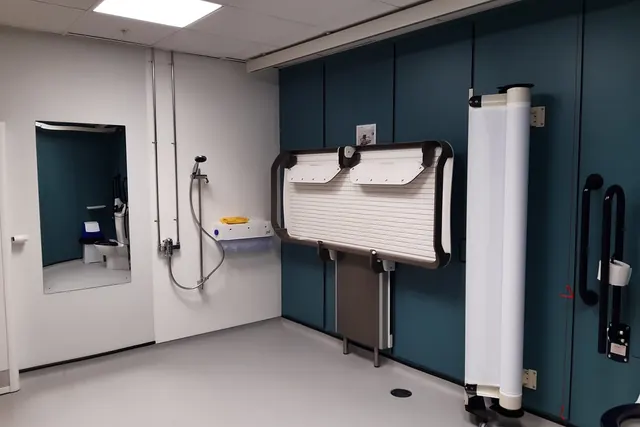
What a Changing Places toilet has
The national schemes in the UK, Ireland, Australia and New Zealand all ask for the same core equipment: an adult-sized changing bench, a hoist, a toilet with space for a carer on each side, and room for a wheelchair and carers. The UK Changing Places Consortium's list:
- A room of at least 12 square metres, much larger than a standard accessible toilet.
- A height-adjustable, adult-sized changing bench.
- A ceiling track hoist, or a mobile hoist where a track is not possible.
- A toilet placed centrally, with room on both sides so carers can help.
- A privacy screen or curtain, a large waste bin and a wide paper roll for the bench.
- Space for the disabled person and up to two carers, and a non-slip floor.
Other countries add details of their own:
- Ireland: Changing Places Ireland gives minimum room dimensions of 4,200 mm by 3,000 mm, a height-adjustable washbasin, a hoist that charges continuously and covers the whole ceiling, and an optional shower.
- Australia: the building code requires a hoist that covers the room on two fixed rails and a moving rail, a change table with a safe working load of at least 180 kg, and at least 900 mm of clear space on each side of the toilet. Changing Places Australia also lists an automatic door with a clear opening of at least 950 mm.
- New Zealand: every accredited room also has a shower on a flexible hose, a sharps bin and a secure entry system for registered users.
Every part of that list matters. Without the bench, the person has to be changed on the floor. Without the hoist, carers have to lift an adult by hand, which risks injury to both. Without the space, two carers and a wheelchair cannot fit in the room at once.
Who needs a Changing Places toilet
People who need help to use the toilet or to be changed, and who cannot safely be helped in a standard accessible toilet. The Changing Places Consortium and the UK government name people with profound and multiple learning disabilities, spinal injuries, muscular dystrophy and multiple sclerosis among them. The consortium, a group of organisations behind the campaign, says more than a quarter of a million people in the UK need these toilets; the government's 2020 announcement put the number of severely disabled people at more than 250,000. Changing Places New Zealand estimates that standard accessible toilets are unsuitable for about 20,000 New Zealanders.
For families, the lack of one can decide whether a day out happens at all. Without a Changing Places toilet nearby, many carers plan trips around getting home in time, or do not go.
How it differs from a standard accessible toilet
A standard accessible toilet, the kind you may open with a RADAR key in the UK, has no changing bench or hoist, and the Changing Places Consortium says most are too small for more than one person. Without a bench and a hoist, someone who needs to be changed lying down has no safe option. That is the gap Changing Places toilets fill.
| Feature | Standard accessible toilet | Changing Places toilet |
|---|---|---|
| Room size | Smaller | At least 12 m² in the UK |
| Changing bench | No adult bench | Adult-sized, height-adjustable |
| Hoist | No | Ceiling track or mobile hoist |
| People inside | Most too small for more than one | The user and up to two carers |
| Getting in | May need a RADAR key in the UK | Varies by country and venue: a key, a member's tag or a call ahead |
How to find one, country by country
Changing Places Australia says the scheme began in the UK in 2006. Ireland, Australia and New Zealand now keep their own registers. Use the official list for the country you are in, and check how to get in before you set off.
United Kingdom
You will find Changing Places toilets in places such as shopping centres, supermarkets, stadiums, arts venues and some council buildings. In England, motorway service areas must have one under the government's rules for roadside facilities. Mobile Changing Places units can also be hired, for example for events. The Changing Places Consortium keeps the official map of registered toilets at changing-places.org, which also covers Northern Ireland. Some venues use a RADAR key, and some ask you to phone ahead.
Ireland
Changing Places Ireland keeps a map of every registered Changing Places toilet in the Republic of Ireland, with the address, contact details, facilities and opening hours. It also marks step-down facilities with a yellow star: rooms with some of the features of a Changing Places toilet but not all of them, which may still be more useful than a standard accessible toilet. Recent openings include one at St James's Hospital. Ways in vary: at Dundrum Town Centre, for example, the charity says a RADAR key and spares are kept at the customer service desk.
Australia
Changing Places Australia's map, at changingplaces.org.au, listed 426 toilets across the country when we checked in November 2026. You can search by town, suburb or postcode, or by state, and filter for a shower or for rooms that need no key. Many Australian Changing Places need a Master Locksmiths Access Key (MLAK). Changing Places Australia recommends that venues keep an MLAK nearby, at a reception desk or a nearby café, with a sign saying where, so you can still get in without your own. For festivals and events, portable units such as the Marveloo can be hired, and the site lists portable toilets at events.
New Zealand
Changing Places New Zealand listed twelve Changing Places on its website when we checked, in places including Auckland, Hamilton, Wellington and Dunedin. Entry is for registered members: you get a coded tag on a retractable lanyard and hold it to a sensor by the door, and the same tag opens every Changing Places in the country. Membership has a one-off fee, which ACC or some disability funding can cover.
United States
In the US, the US Access Board calls the equipment a universal changing table, also known as an adult changing table: a table on which a person with a disability is helped by a caregiver with toileting. The federal ADA accessibility guidelines, last revised in 2004, contain no specific requirements for adult changing tables, and we know of no national register like the ones above. Ask the venue directly before you go. From fiscal year 2030, medium and large hub airports that apply for federal airport development grants must provide at least one private room with a universal changing station in each passenger terminal.
Other countries
Changing Places Australia links to the national Changing Places websites for the UK, New Zealand, Ireland and Canada, where the campaign is run as Accessible Washrooms for All. For accessible toilets in cities elsewhere, see wheelchair accessible toilets.
The rules for new buildings
England
Changes to the building regulations guidance (Approved Document M) took effect in January 2021: new or majorly refurbished large buildings that the public uses, such as shopping centres, supermarkets, cinemas, stadiums and arts venues, must include a Changing Places toilet. The rule does not cover existing buildings. For those, the government announced a £30 million fund in 2021, given out through councils across England. The Changing Places Consortium worked with the British Standards Institution to include Changing Places toilets in BS 8300, the British Standard on accessible buildings, in 2009.
Ireland
Changing Places Ireland says new rules took effect on 1 January 2023 that require Changing Places toilets in certain sizes of building nationwide, under the Building Regulations (Part M Amendment) Regulations 2022. The National Disability Authority's Universal Design Guidelines for Changing Places Toilets, launched in 2024, give good-practice advice on where to put them, how to design them and how to look after them.
Australia
Changing Places Australia says the National Construction Code has required accessible adult change facilities, based on Changing Places designs, in certain public buildings since 2019. In the 2022 code, they are required in shopping centres with a design occupancy of at least 3,500 people, sports venues for at least 35,000 spectators or with an accessible pool at least 70 m round, museums, galleries and theatres for at least 1,500 people, and passenger areas of airport terminals.
United States
The FAA Reauthorization Act of 2024 set the airport requirement above and asked the US Access Board to write design standards for the tables and their rooms; the board began that rulemaking in February 2026. An industry standard already exists, section 613 of ICC A117.1-2017 with Supplement 1, and it was added to the International Building Code in 2024. When it was written, its working group reviewed state laws then in progress in 12 US states and one Canadian province, so your state may have its own rules.
Each national scheme lists the features a toilet needs before it can be registered. In New Zealand, a room must be accredited by Changing Places New Zealand before it can use the name or the logo; in the UK, rooms that have only some of the features can be listed separately as other changing facilities.
Planning a visit
- Check the official Changing Places map for the country, and check opening hours with the venue.
- Find out how to get in: a RADAR key in some UK venues, an MLAK at many in Australia, a member's tag in New Zealand, or a phone call ahead.
- Phone ahead if the visit depends on it, to check the hoist is working and the room is not out of use.
- If you use a hoist sling, ask whether the venue provides one, and take your own if not.
- Note a second option, such as a large supermarket or hospital, in case the first is closed.
For the standard accessible and RADAR toilets along a UK route, use our council area pages: each one lists every public toilet with its opening hours and whether it is accessible.
Changing Places toilets in our data
The UK data we use has no separate field for Changing Places, so we cannot list them reliably yet. 110 UK toilet records mention Changing Places in their name or notes; you will see those notes on each council area page. Outside the UK, our city pages come from OpenStreetMap. For a complete list in any country, use the national map.
If you run a venue
Register your toilet with the national scheme so people can find it, and keep the entry up to date: the Changing Places Consortium in the UK, Changing Places Ireland, Changing Places Australia, which has an accreditation and registration process, or Changing Places New Zealand, which must accredit a room before it can use the name. Check the hoist is serviced, the bench works and the room is not used for storage. Tell staff where the toilet is and how to open it, and put the opening arrangements on your website: for many families, that one line decides whether they visit.
What families say helps
The equipment matters, but so do details that are easy for a venue to get right and easy to overlook:
- Clear information online. Where the toilet is, its opening hours, how to get in and who to ask, on the venue's own website.
- A working hoist. Regular servicing, a charged battery and a clear sign if it is out of order, so families do not discover it on arrival.
- A clean, uncluttered room. A Changing Places toilet used for storage is no use to the people who need it.
- Staff who know where the key is. A locked toilet with nobody able to open it is no better than no toilet.
- A shower, which the UK consortium recommends but does not require, and which every accredited room in New Zealand has.
If a Changing Places toilet you rely on is closed or poorly kept, tell the venue and the national scheme that keeps the register, such as the Changing Places Consortium in the UK. For venues, the consortium's installation FAQs explain what a registered UK toilet needs.
Common questions
Who can use a Changing Places toilet?
Anyone who needs the extra space and equipment, usually with one or two carers. They are designed for people who cannot use a standard accessible toilet, such as many people with profound and multiple learning disabilities, spinal injuries, muscular dystrophy or multiple sclerosis.
Do I need a key for a Changing Places toilet?
It depends on the country and the venue. In the UK, the Changing Places Consortium says some venues use a RADAR key and some ask you to phone ahead. In Australia, many need a Master Locksmiths Access Key (MLAK). In New Zealand, registered members open the door with a coded tag. Check the arrangements with the venue before you travel.
How big is a Changing Places toilet?
In the UK, at least 12 square metres, with enough space for a wheelchair, a height-adjustable adult changing bench, a hoist and up to two carers. Changing Places Ireland gives a minimum of 4,200 mm by 3,000 mm. A standard accessible toilet is much smaller: the Changing Places Consortium says most are too small for more than one person.
How do I find a Changing Places toilet near me?
Use the official map for the country: changing-places.org for the UK, including Northern Ireland; the Changing Places Ireland map for the Republic of Ireland; changingplaces.org.au for Australia; and the locations list on the Changing Places New Zealand website. In the US, ask the venue whether it has a universal or adult changing table.
Are there Changing Places toilets in the US?
The US uses the term universal changing table, also known as an adult changing table. The federal ADA accessibility guidelines have no specific requirement for one, but from fiscal year 2030, medium and large hub airports that seek federal development grants must provide a private room with a universal changing station in each passenger terminal. Ask the venue before you go.