Access and comfort
The best raised toilet seats and toilet frames
Ask for an assessment first: an occupational therapist can tell you the height and support you need, and in England your council must provide assessed equipment under £1,000 free. If you buy your own, the Carex E-Z Lock adds 5 inches and locks onto the bowl, the Drive Medical seat comes in 2, 4 or 6 inch heights, and the Carex stand-alone frame adds handholds without fixing to the toilet.
Last reviewed
Affiliate links. As an Amazon Associate, toiletnearest.com earns from qualifying purchases. Prices and stock are on Amazon and change often, so check them there. How we choose products.
Our picks at a glance
- Best clamp-on raised seatCarex E-Z Lock Raised Toilet SeatCheck price on Amazon: Carex E-Z Lock Raised Toilet Seat (affiliate link, opens in a new tab)
- Best choice of heightsDrive Medical Raised Toilet Seat with LidCheck price on Amazon: Drive Medical Raised Toilet Seat with Lid (affiliate link, opens in a new tab)
- Best riser under your own seatCarex Hinged Toilet Seat RiserCheck price on Amazon: Carex Hinged Toilet Seat Riser (affiliate link, opens in a new tab)
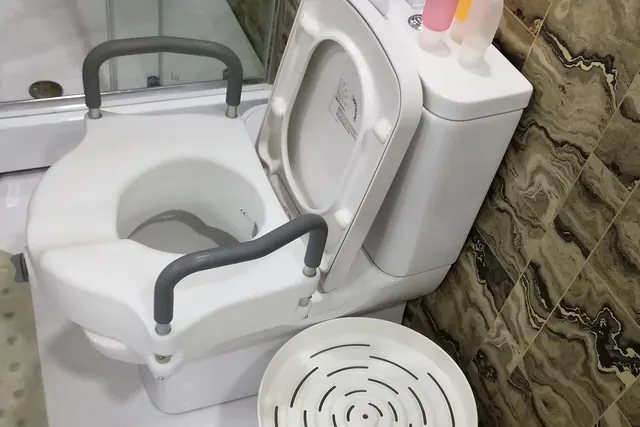
- Best portable seat with armsCarex E-Z Lock Raised Toilet Seat with ArmrestsCheck price on Amazon: Carex E-Z Lock Raised Toilet Seat with Armrests (affiliate link, opens in a new tab)
- Best riser with removable armsVive Toilet Seat Riser with ArmsCheck price on Amazon: Vive Toilet Seat Riser with Arms (affiliate link, opens in a new tab)
- Best frame fixed to the toiletVive Toilet Safety RailCheck price on Amazon: Vive Toilet Safety Rail (affiliate link, opens in a new tab)
- Best free-standing frameCarex Stand-Alone Adjustable Toilet Safety FrameCheck price on Amazon: Carex Stand-Alone Adjustable Toilet Safety Frame (affiliate link, opens in a new tab)
Get an assessment first
The right equipment depends on how you move, the toilet you use and the space around it, and an occupational therapist can assess all three. None of the products on this page replaces that. Living Made Easy, the UK equipment advice service, says that if you have not discussed your toileting difficulties with a professional, you are strongly advised to seek an assessment, and that occupational therapists can advise on equipment. Your doctor can refer you on if needed. UK NHS leaflets on this equipment, such as those from Kingston and Richmond and from East Sussex Healthcare, are written for people an occupational therapist has assessed. Outside the UK, ask your doctor or local health service about an occupational therapy assessment and any help with equipment costs.
In England, you can also ask your council. The NHS website says to ask the adult social services department of your local council for a home assessment, online or by phone, and that a trained professional from the council, or an occupational therapist, will visit you at home to see what you need. It says:
- Having a needs assessment is free.
- If the assessment finds you need a piece of equipment that costs less than £1,000, the council must provide it free of charge.
- If a hospital gives you equipment to use when you get home, such as a toilet surround frame, this should also be free.
GOV.UK's online service to apply for a needs assessment covers England and Wales only. If you live elsewhere in the UK, ask your GP or local council how to get an assessment.
In the UK, if you buy your own, ask the supplier about VAT relief. HMRC's VAT Notice 701/7 lets suppliers zero-rate frames or other devices to help sitting on or rising from a sanitary appliance, such as a toilet, when supplied to a disabled or chronically sick person for their own personal or domestic use, on a signed declaration. It does not cover an older person who is not disabled or chronically sick.
The picks in detail
Five seats and risers, then two frames. For each we give how much height it adds or how high it stands, how it fixes, the weight limit and whether it has arms, all from the maker's own product page, linked under each pick. These makers give weight limits in pounds (lb). Use them alongside your assessment, not instead of it.
1. Best clamp-on raised seat
Carex E-Z Lock Raised Toilet Seat
Adds 5 inches and locks onto the toilet bowl, with hand grips moulded into the seat. Carex designs it to be attached and removed easily, so it can move to another bathroom, and rates it to 300 lb.
- Height added
- 5 in
- Weight capacity
- 300 lb
- Fixing
- Locking mechanism secures it to the bowl
- Fits
- Most toilets
- Size (H x W x D)
- 5 x 15.5 x 17 in
- Weight
- 4.5 lb
Good
- Locks onto the bowl rather than just resting on it
- Built-in hand grips on the seat
- Light enough at 4.5 lb to move between bathrooms
Bear in mind
- One height only: check that 5 in still leaves your feet flat on the floor
- No armrests: the version with armrests is further down this list
Check price on Amazon: Carex E-Z Lock Raised Toilet Seat (affiliate link, opens in a new tab)Specs: Carex: E-Z Lock Locking Raised Toilet Seat
2. Best choice of heights
Drive Medical Raised Toilet Seat with Lid
Drive sells this locking raised seat in 2, 4 and 6 inch heights, so you can match the height an assessment suggests rather than take the one size on offer. The 2 and 4 inch versions have a lid, and the weight capacity is 400 lb, the highest here.
- Heights
- 2, 4 or 6 in
- With a lid
- 12063 (2 in) and 12065 (4 in)
- Weight capacity
- 400 lb
- Seat (W x D)
- 14 x 16 in
- Fits
- Standard toilets
- Fixing
- Locking device with a heavy-duty worm screw and locking plate; no tools
Good
- Three heights to choose from
- 400 lb weight capacity
- Fits without tools
- Limited lifetime warranty from Drive
Bear in mind
- Drive lists it for standard toilets, so check your bowl shape
- The 6 in version comes without a lid
Check price on Amazon: Drive Medical Raised Toilet Seat with Lid (affiliate link, opens in a new tab)Specs: Drive Medical: Raised Toilet Seat with/without Lid
3. Best riser under your own seat
Carex Hinged Toilet Seat Riser
A riser that fits between the bowl and your own toilet seat, adding 3.5 inches while keeping your seat and lid. Because it is hinged, it lifts like a normal seat so you can clean underneath. Made in standard and elongated sizes.
- Height added
- 3.5 in
- Weight capacity
- 300 lb
- Fitting
- Bolted between the bowl and your existing seat
- Hinged
- Yes
- Size (H x W x D)
- 3.5 x 13.75 x 17.25 in (standard); 19.25 in deep (elongated)
- Weight
- 3.2 lb
Good
- Keeps your own seat and lid
- The hinge lifts it for cleaning hard-to-reach areas
- Separate sizes for standard and elongated bowls
Bear in mind
- Bolted on, so it is not one to take away with you
- 3.5 in adds less height than the clamp-on seats
Check price on Amazon: Carex Hinged Toilet Seat Riser (affiliate link, opens in a new tab)Specs: Carex: Hinged Toilet Seat Riser
4. Best portable seat with arms
Carex E-Z Lock Raised Toilet Seat with Armrests
The E-Z Lock seat with padded armrests, for people who want something to hold while they sit down and stand up. It locks onto the bowl the same way and, like the plain version, is made to move between bathrooms.
- Height added
- 5 in
- Weight capacity
- 300 lb
- Between the armrests
- 17.25 in
- Size (H x W x D)
- 5 x 15.5 x 17 in
- Weight
- 5.6 lb
- Fixing
- Locking mechanism secures it to the bowl
Good
- Padded armrests on both sides
- Locks onto the bowl
- Can move between bathrooms
Bear in mind
- Heavier than the plain E-Z Lock (5.6 lb against 4.5 lb)
- Ask an occupational therapist whether arms on the seat or a separate frame suits you better
Check price on Amazon: Carex E-Z Lock Raised Toilet Seat with Armrests (affiliate link, opens in a new tab)Specs: Carex: E-Z Lock Locking Raised Toilet Seat with Armrests
5. Best riser with removable arms
Vive Toilet Seat Riser with Arms
A 3.5 inch riser that fits under your own seat, with padded aluminium handles that come off for cleaning or when you need the space. Vive rates it to 300 lb and makes standard and elongated sizes.
- Height added
- 3.5 in
- Weight capacity
- 300 lb
- Fitting
- Under your existing seat, with the hardware supplied; no tools
- Handles
- Removable aluminium, foam padded
- Between the handles
- 19 in
- Handle height
- 9.5 in above the toilet rim
Good
- Handles come off when you need the space
- Keeps your own toilet seat
- Fits without tools
Bear in mind
- Vive says it needs a toilet with an interior bowl lip
- 3.5 in adds less height than the clamp-on seats
Check price on Amazon: Vive Toilet Seat Riser with Arms (affiliate link, opens in a new tab)Specs: Vive Health: Toilet Seat Riser with Arms
6. Best frame fixed to the toilet
Vive Toilet Safety Rail
Armrests on both sides, fixed to the toilet with its own seat bolts and with legs down to the floor, so there is no drilling. Width and height both adjust, which helps set the arms at the right height, and Vive says it comes apart for travel.
- Width
- 21.5 to 26.5 in
- Height
- 26 to 31.5 in
- Weight capacity
- 300 lb
- Fixing
- Existing seat bolts; no drilling
- Frame
- Aluminium, corrosion resistant
- Feet
- Rubber non-slip caps
Good
- Adjusts in width and height
- No drilling or cementing
- Comes apart for travel
Bear in mind
- Fitting it means taking the toilet seat off
- The legs need clear, level floor either side of the toilet
Check price on Amazon: Vive Toilet Safety Rail (affiliate link, opens in a new tab)Specs: Vive Health: Toilet Safety Rail
7. Best free-standing frame
Carex Stand-Alone Adjustable Toilet Safety Frame
A frame that stands around the toilet without fixing to it, so it can be placed or moved where it is needed and set up without tools. Its height adjusts from 24 to 29 inches, and the aluminium frame is rated to 300 lb.
- Height
- 24 to 29 in
- Weight capacity
- 300 lb
- Material
- Aluminium
- Fixing
- Stands alone; nothing fixed to the toilet
- Assembly
- Tool-free
- Extra
- Built-in magazine rack
Good
- Nothing to fix to the toilet or floor
- Height adjusts
- Sets up without tools
Bear in mind
- Carex gives no width, so measure the space around your toilet
- An NHS (UK) leaflet warns a free-standing frame may tip if you lean heavily to one side
Check price on Amazon: Carex Stand-Alone Adjustable Toilet Safety Frame (affiliate link, opens in a new tab)Specs: Carex: Stand-Alone Adjustable Toilet Safety Frame
How to choose
Living Made Easy describes raised toilet seats as fitting on top of a toilet bowl to raise the height of the seat. A clamp-on seat replaces your seat while it is fitted and can be moved; a riser fits under your own seat and stays put. Frames add handholds instead: Living Made Easy says they can be free-standing or fixed, and notes that they are more obtrusive.
- Height. Living Made Easy says your feet should be flat on the floor when seated, and that a seat that is too high can leave you feeling unsupported. Higher is not always better.
- Whether you need your arms. The Kingston and Richmond leaflet says a raised seat should not be used if you cannot get on and off without using your arms, such as steadying yourself on a radiator; a different piece of equipment would be issued. Ask an occupational therapist what would suit you instead.
- How it fits your toilet. Some raised seats clamp onto the bowl; others use the toilet's standard seat fixings. Living Made Easy says seats fixed through the existing hinge may be more secure on bowls with a non-traditional shape. Check whether your bowl is round or elongated against what the maker lists.
- Weight limit. Check the maker's stated maximum user weight. On the products here it is 300 lb, or 400 lb for the Drive Medical seat.
- Room around the toilet. The Kingston and Richmond leaflet says not to use a frame if the floor is uneven or weak, if the legs would be a trip hazard, or if there is not enough space or the pipes make it unsafe.
- Strength and balance. The same leaflet says not to use a frame if your arms or upper body are weak, or if you are weak on one side or lean heavily to one side, as the frame may tip over. An occupational therapist can suggest other options.
- Special seats. Living Made Easy lists sloped or cut-away seats for people who cannot bend one hip. After hip surgery, follow your hospital team's advice.
Using it safely
- Fit a seat as the leaflet describes. The Kingston and Richmond leaflet says to lift both the lid and the seat of the toilet, secure the adjustable brackets to the bowl, and check that both feet can rest flat on the floor. If they cannot, do not use the seat.
- Check it before you sit. The leaflet says not to use a raised seat if the brackets or the toilet's own fixtures are loose, and warns that balance problems or spasms can loosen the brackets. Check again whenever you move it to a different toilet.
- Set up a frame correctly. The frame leaflet says the crossbar goes at the front of the toilet bowl, not behind it; all four feet should be flat on the floor; and the ferrules (rubber feet) should not be worn down. The frame should sit at about elbow height, and you should be able to sit with your feet flat on the floor and your hips at 90 degrees.
- Follow the maker's instructions. Fit it as the manual says, and stay within the stated weight limit.
- Leave walking aids aside. Living Made Easy says that if you use walking equipment, avoid using it to help you stand or sit.
- Report faults, and return what you no longer need. If the equipment came from a council or hospital, ask them about repairs and collection. The Kingston and Richmond leaflets tell people to contact their local equipment supplier to collect it or request a repair.
When an accessible toilet is better
Carrying equipment is not the only way to manage away from home. Living Made Easy notes that accessible public toilets are designed to provide better facilities with more space. Our pages list wheelchair accessible toilets and toilets with a RADAR lock; our guide explains what a RADAR key is and where to get one.
If a standard accessible toilet is not enough, a Changing Places toilet has a centrally placed toilet with room either side, wall-mounted grab rails and drop-down support rails on both sides, and a ceiling track hoist. Read our Changing Places guide, or use the toilet finder to see what is near you.
Questions
Can I get a raised toilet seat for free?
In England, often yes. The NHS says to ask your council's adult social services for a needs assessment, which is free, and that if the assessment finds you need a piece of equipment costing less than £1,000, the council must provide it free of charge. Equipment a hospital gives you to use at home should also be free. Elsewhere, ask your doctor or local health service what help is available.
How high should a raised toilet seat be?
High enough to make sitting and standing easier, but no higher. Living Made Easy says your feet should be flat on the floor when seated, and that a seat that is too high can leave you feeling unsupported. The seats here add between 2 and 6 inches; an occupational therapist can measure what you need.
Will a raised toilet seat fit my toilet?
Check your bowl shape first. Vive explains that standard toilets are more circular, while elongated ones are more oval and several inches longer than they are wide. Makers say what their seats fit: Drive lists its seat for standard toilets, Carex makes its hinged riser in standard and elongated sizes, and Vive says its riser needs a bowl with an interior lip. Living Made Easy says seats fixed through the existing hinge may be more secure on bowls with a non-traditional shape.
Raised seat or toilet frame?
It depends on whether you need your arms. An NHS (UK) occupational therapy leaflet says a raised seat should not be used if you cannot get on and off without using your arms; a frame gives handholds instead, but needs room around the toilet and is not suitable for everyone. An occupational therapist can advise which suits you.
Do I have to pay VAT on a raised toilet seat in the UK?
Not always. HMRC's VAT Notice 701/7 lets UK suppliers zero-rate devices that help a disabled or chronically sick person sit on or rise from a toilet, for their own personal or domestic use, on a signed declaration. It does not cover an older person who is not disabled or chronically sick.
Can I take a raised toilet seat on holiday?
Clamp-on seats such as the Carex E-Z Lock are designed to be taken off and moved, and Vive says its toilet safety rail comes apart for travel. Check the fixings every time you fit it to a new toilet, and do not use it if they are loose.