Using toilets in Japan
Public toilets in Japan are cleaned daily and are basically free to use, according to the Japan Sanitary Equipment Industry Association. The main challenge for visitors is the control panel. This guide explains the buttons, the etiquette and where to go; for the toilets themselves, see public toilets in Japan, city by city.
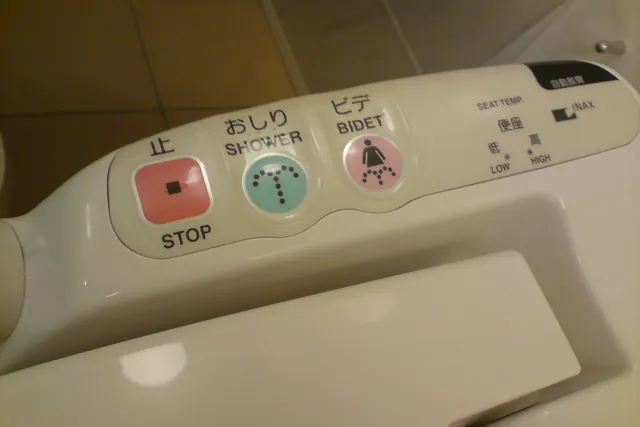
The control panel
Many toilets in Japan have a seat with a built-in warm-water washer, often called a washlet after the TOTO product launched in 1980. The controls are buttons on the side of the seat or a panel on the wall. In 2017 the Japanese sanitary industry brought in standard pictograms for the main buttons, to help visitors from abroad, but not every panel uses them, so it helps to know the main characters.
| Label | What it does |
|---|---|
| 止 | Stop. Ends a wash. Learn this one first. |
| おしり | Rear wash. |
| ビデ | Front wash for women. |
| 乾燥 | Dryer. |
| 流す | Flush. |
| 大 / 小 | Full flush / light flush. |
Sit down before you press anything, and if in doubt, press 止 (stop).
Flushing
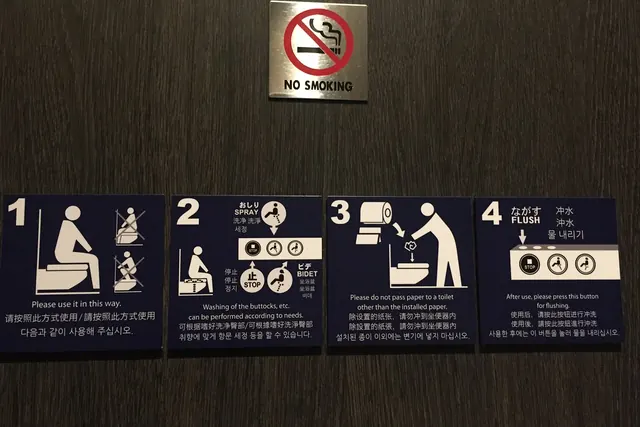
Toilets flush in several ways: a lever on the side of the tank or on the toilet, a button on the wall, a sensor you hold your hand over, or a button on the washlet's remote. Some of the newest toilets flush on their own when you stand up. Look for 流す (flush). The emergency call button is near the flush button, so read the labels before you press: use it only in a real emergency.
Toilet paper goes in the toilet. Only toilet paper and other flushable paper should be flushed. Sanitary pads and tampons go in the bin beside the toilet.
Squat toilets
Japanese-style toilets (和式, washiki) are squat toilets: you squat over them rather than sit. Western-style toilets (洋式, yōshiki) are now the most common type in Japan. If you would rather not use a squat toilet, look for a Western-style one. If you have not used one before, read how to use a squat toilet.
Etiquette
- Toilet slippers. Where you take your shoes off indoors, there is often a separate pair of slippers for the toilet. Change into them, and back into your own slippers when you leave.
- Flush every time, with the next person in mind.
- Ask first in a shop or other business. In some places you need permission before you use the toilet, so ask a member of staff.
Where to find a toilet
The Japan Sanitary Equipment Industry Association lists airports, stations, places to stay, convenience stores, shops and other commercial buildings, and parks among the places with toilets. In some of them you may need to ask permission first.
Convenience stores
Japan's convenience stores (konbini) are among the places with toilets. Ask a member of staff before you use one.
Stations
Stations are among the places with toilets. A station toilet may be inside or outside the ticket gates, so check the station map before you go through.
Shops and shopping centres
Commercial buildings such as shopping centres are another place to look.
Parks
Parks have public toilets too. Most toilets have toilet paper, but some may have run out, so carry some flushable tissue.
Accessible toilets
Look for the multi-function toilet (多目的トイレ, tamokuteki toire). These are roomier than other toilets, with priority for wheelchair users, people with an ostomy and people with babies. See wheelchair accessible toilets for more.
The Tokyo Toilet
In Shibuya, Tokyo, the Nippon Foundation's Tokyo Toilet project redesigned public toilets at 17 locations, with designs by 16 creators including Tadao Ando, Shigeru Ban and Kengo Kuma. The 17th was finished in March 2023, and from 1 April 2024 the toilets passed to Shibuya City, which now manages them. At Shigeru Ban's toilets in Haru-no-Ogawa Community Park, the transparent glass walls turn opaque when you lock the door.
Wim Wenders's film Perfect Days, shot in Tokyo in October 2022, stars Koji Yakusho as a man who cleans the Tokyo Toilet toilets. He won best actor for the role at the 76th Cannes Film Festival.
Public toilets in Tokyo, Osaka and Kyoto
Our city pages list the public toilets that OpenStreetMap volunteers have mapped near each city centre, with the facts they have recorded. Toilets in stations, shops and convenience stores may not be mapped as public toilets, so the real choice may be wider.
| City | Toilets mapped | Wheelchair accessible | Baby changing | Snapshot |
|---|---|---|---|---|
| Tokyo | 863 | 212 | 104 | 17 November 2026 |
| Osaka | 453 | 93 | 20 | 17 November 2026 |
| Kyoto | 511 | 82 | 17 | 17 November 2026 |
What to carry
- A small hand towel, in case there are no paper towels or dryer.
- Flushable tissue. Most toilets have paper, but some may have run out. You can buy flushable tissue at convenience stores and supermarkets.
- Hand gel, for toilets without soap.
- A coin purse is rarely needed for toilets: public toilets in Japan are basically free.
Useful words and signs
If a sign has no English or pictogram, these words help:
| Japanese | Reading | Meaning |
|---|---|---|
| トイレ | toire | Toilet |
| お手洗い | otearai | Toilet |
| 化粧室 | keshōshitsu | Toilet, powder room |
| 男性 | dansei | Men |
| 女性 | josei | Women |
| 多目的トイレ | tamokuteki toire | Multi-function (accessible) toilet |
| 和式 / 洋式 | washiki / yōshiki | Japanese-style (squat) toilet / Western-style toilet |
| 流す | nagasu | Flush |
To ask where the toilet is, say トイレはどこですか (toire wa doko desu ka). For the words on toilet signs in other countries, see the word for toilet around the world.
On trains and at stations
Stations are among the places with toilets in Japan, and public toilets are basically free. A station toilet may be inside or outside the ticket gates, so check the station map before you go through.
Shinkansen bullet trains and long-distance buses have toilets on board. On other trains, use the station toilet before a long ride in case there is none on board.
Common questions
Are public toilets free in Japan?
Basically, yes. The Japan Sanitary Equipment Industry Association says public toilets in Japan are basically free to use.
Can I use the toilet in a convenience store in Japan?
Convenience stores are among the places in Japan with toilets, but in some places you need permission first, so ask a member of staff.
Can I flush toilet paper in Japan?
Yes. Leave toilet paper in the bowl and flush it. Only toilet paper and other flushable paper should go down the toilet; sanitary products go in the bin beside the toilet.
What do the buttons on a Japanese toilet do?
The main labels are 止 (stop), おしり (rear wash), ビデ (front wash for women), 乾燥 (dryer) and 流す (flush), with 大 for a full flush and 小 for a light one. The Japanese industry's standard pictograms cover seven functions: full flush, light flush, rear wash, front wash, dryer, and opening or closing the seat and the lid. If in doubt, press 止.
Are there squat toilets in Japan?
Some. Western-style toilets are now the most common in Japan, but you may still find Japanese-style toilets, which you squat over.