Travel, camping and long drives
Composting toilet or chemical toilet?
Choose a chemical toilet if you stay on campsites with a chemical disposal point and want a flush like home: the Thetford Porta Potti 365 holds 5.5 gallons of waste. Choose a composting (urine-separating) toilet if you spend long spells off-grid: it uses no water or chemicals, urine can be poured into any toilet, and bagged solids can go in household waste where local rules allow.
Last reviewed
Affiliate links. As an Amazon Associate, toiletnearest.com earns from qualifying purchases. Prices and stock are on Amazon and change often, so check them there. How we choose products.
Side by side
Two portable chemical toilets and two composting toilets, one fitted and one portable. Every value below comes from the maker's own page; where a maker does not publish a figure, the table says so. Capacities are not like for like: a chemical toilet holds everything in one tank, while a composting toilet keeps urine and solids apart.
| Thetford Porta Potti 365 | Dometic 976 Portable Toilet | Nature's Head Composting Toilet | Trelino Evo S | |
|---|---|---|---|---|
| Best for | Chemical toilet with the biggest tank of the four | Chemical toilet with a push-button flush | Fitted composting toilet for long trips | Portable composting toilet with no power |
| Waste capacity | 5.5 gal (20.8 l) waste tank | 5 gal (18.9 l) waste tank | Urine 2.2 gal (8.3 l); solids about 60 to 80 uses | Urine 4.5 l (1.2 gal); solids 6.5 l (1.7 gal) |
| Flush water | 4 gal (15.1 l) tank | Not stated | None | None |
| Flush | Piston pump | Push button | None: agitator handle mixes the solids | None |
| Size (H x W x D) | 16.29 x 15.07 x 16.81 in (41.4 x 38.3 x 42.7 cm) | 15.25 x 13.125 x 15.25 in (38.7 x 33.3 x 38.7 cm) | 21 x 20 x 19 in (53 x 51 x 48 cm) | 29.6 x 33.0 x 39.0 cm (11.7 x 13.0 x 15.4 in) |
| Seat height | 16.06 in (40.8 cm) | 15.25 in (38.7 cm) | About 20 in (51 cm), from the maker's drawing | Not stated |
| Weight | Not stated | 14 lb (6.4 kg) | 23 lb (10.4 kg) | 3.9 kg (8.6 lb) |
| Price | Check price on Amazon: Thetford Porta Potti 365 (affiliate link, opens in a new tab) | Check price on Amazon: Dometic 976 Portable Toilet (affiliate link, opens in a new tab) | Check price on Amazon: Nature's Head Composting Toilet (affiliate link, opens in a new tab) | Check price on Amazon: Trelino Evo S (affiliate link, opens in a new tab) |
How each one works
A chemical toilet, whether a portable one or a cassette built into a motorhome, flushes with water into a single waste tank. Thetford says smell is controlled with toilet additives and regular emptying. In practice that means two products: the Camping and Caravanning Club says flush additives are usually pink and go in the flush reservoir, while waste tank chemicals are usually blue or green, with green ones often marketed as the more environmentally friendly option.
A composting toilet of the kind sold for vans and boats is a urine-separating toilet. It uses no flush water. Urine goes to a bottle at the front, and solids to a separate container, where a dry medium such as coco coir, peat moss or sawdust soaks up moisture. Fitted models add a small fan to dry the solids and carry smells outside.
Despite the name, do not expect a van or boat composting toilet to turn waste into finished compost between empties. The US EPA notes that composting toilets rarely get hot enough to destroy pathogens quickly, so time matters more than heat, and Air Head says not to use the contents on anything you plan to eat. Treat what you empty as waste, not as garden compost.
Emptying: the real difference
How and where you empty the toilet is the biggest practical difference between the two, so decide on this first.
A chemical toilet
The Camping and Caravanning Club's first rule is that a chemical toilet must only be emptied in a designated disposal area, usually signed Chemical Disposal Point (CDP) or Elsan point. If there is none, the only alternative is an ordinary toilet, which may mean taking the waste home. Never empty it into a grey water or fresh water point. Thetford says most campsites and motorhome sites, and many motorway service areas, have facilities to empty a cassette. Our step-by-step guide to emptying a chemical toilet covers the routine, and RV dump stations covers emptying in North America.
Check the site rules for chemicals too. The Club says some campsites only allow specific toilet chemicals in their disposal points, and sites on a septic tank may have strict rules because some chemicals harm the bacteria. Our comparison of blue and green toilet chemicals explains the difference.
A composting toilet
Thetford says urine can simply be poured into any regular toilet, and that bagged solids can be put out with household waste, always checking local regulations. On a campsite, the Club's advice for bagged waste is to ask the staff: some sites allow it in the general bins and others ask you to take it home. Never flush the bags.
How often
A chemical toilet's single tank fills with flush water as well as waste. Thetford says the green waste indicator on a Porta Potti shows when to empty it, after about 27 to 33 flushes depending on the model.
A composting toilet splits the job in two. The urine bottle needs emptying often: Air Head says its 2 gal bottle lasts two people about 2 to 4 days. Solids last much longer, about 60 to 80 uses in a Nature's Head, says the maker, and Air Head says a cruising couple empties its solids tank about once a month. Small portable models fill faster: Trelino gives 6 to 8 uses for the Evo S solids container.
On a boat
In US no-discharge zones, the EPA bans both treated and untreated sewage discharges from vessels; sewage must stay on board until a pump-out or until you are beyond three miles from shore. A composting toilet removes the need for pump-outs of solids, but Air Head says US rules prohibit discharging untreated urine into any waterway, so plan where the urine bottle will be emptied. For flushing heads, see the best marine toilets.
Water, chemicals, power and smell
- Water. A chemical toilet needs clean water for every flush: the Porta Potti 365 carries 4 gal (15.1 l). A composting toilet uses none, which matters on a long trip with a small fresh water tank.
- Chemicals and consumables. A chemical toilet needs a waste tank chemical and usually a flush additive; see the best toilet chemicals. A composting toilet needs a dry medium such as coco coir, and Thetford says any drying agent is optional on its separation toilet. Keep a block of coco coir (Amazon search, affiliate link, opens in a new tab) in the van.
- Power. Portable chemical toilets flush by hand pump or push button, with no wiring. Fitted composting toilets usually run a 12 V fan, so they need a supply and a vent to the outside. Portable separating toilets such as the Trelino Evo S need neither.
- Smell. Thetford says a cassette toilet controls smell with additives and regular emptying, while a separation toilet depends on good ventilation and optional consumables.
- Feel. Thetford says the familiar way of using a flushing toilet is one of the main reasons owners choose a cassette. A composting toilet asks a little more: you add medium, turn a handle on fitted models and empty the urine bottle often.
- Seat height. The chemical toilets here have seats of 15.25 in (Dometic 976) and 16.06 in (Porta Potti 365). Nature's Head's own drawing puts its seat at about 20 in, while the Trelino Evo S is only 29.6 cm (11.7 in) high overall.
Which suits which trips
Thetford, which makes both kinds, sums it up this way. A cassette toilet fits best if you travel mainly between motorhome sites and campsites, value familiarity and comfort, and want a low-involvement toilet. A separation toilet fits best if you spend a long time off-grid, want to minimise water and additive use, and value flexibility while travelling. Its conclusion is that neither is better; they suit different expectations.
- Weekends on campsites. A chemical toilet, emptied at the site's disposal point. Our comparison of the Porta Potti and the Dometic 970 helps pick one.
- Wild camping and long trips off-grid. A composting toilet: no disposal point needed, and the urine can go in any toilet you pass.
- Liveaboard boats. A fitted composting toilet saves pump-outs of solids; our comparison of the Nature's Head and the Air Head covers the two common marine choices.
- Motorhomes with a cassette already fitted. Thetford makes a separation kit that converts its C220 and C260 cassette toilets, emptied through the same outside service door. Compare the best cassette toilets if you are replacing one.
- Festivals and occasional nights. Either works; a small portable model is easiest to stow. See our guide to festival toilets for what to expect on site.
Which to choose
- Thetford Porta Potti 365 if you want a flush like home and the biggest single waste tank of the four, and your campsites have a disposal point.
- Dometic 976 if you want a chemical toilet with a push-button flush in a smaller box than the Porta Potti 365.
- Nature's Head if the toilet will be fitted in a van, boat or cabin and you want weeks, not days, between solids empties.
- Trelino Evo S if you want a composting toilet with no power or fitting that you can lift out and stow.
Our buying guides go further: the best composting toilets compares seven, including the Air Head, OGO and Separett, and the best portable camping toilets covers flushing, bucket and folding toilets. And on a day trip, a public toilet means nothing to empty: our nearest toilet finder shows the closest.
The toilets compared
1. Chemical toilet with the biggest tank of the four
Thetford Porta Potti 365
A portable flushing toilet with a 4 gal clean water tank on top of a 5.5 gal waste tank, a piston-pump flush and a waste level indicator. A sound choice for a tent, awning or van when your campsites have a chemical disposal point.
- Waste capacity
- 5.5 gal (20.8 l) waste tank
- Flush water
- 4 gal (15.1 l) tank
- Flush
- Piston pump
- Size (H x W x D)
- 16.29 x 15.07 x 16.81 in (41.4 x 38.3 x 42.7 cm)
- Seat height
- 16.06 in (40.8 cm)
- Level indicator
- Waste tank
Good
- Flushes like a home toilet
- Waste level indicator shows when to empty
- No power, fitting or vent needed
Bear in mind
- Must be emptied at a chemical disposal point or into an ordinary toilet
- A full 5.5 gal tank is heavy to carry
- Needs toilet chemicals and clean water
Check price on Amazon: Thetford Porta Potti 365 (affiliate link, opens in a new tab)Specs: Thetford: Porta Potti 365
2. Chemical toilet with a push-button flush
Dometic 976 Portable Toilet
A 5 gallon portable toilet in high-strength ABS with a push-button flush and a prismatic tank level indicator. For anyone who would rather press a button than pump a piston.
- Waste capacity
- 5 gal (18.9 l) waste tank
- Flush
- Push button
- Size (H x W x D)
- 15.25 x 13.125 x 15.25 in (38.7 x 33.3 x 38.7 cm)
- Seat height
- 15.25 in (38.7 cm)
- Weight
- 14 lb (6.4 kg)
- Level indicator
- Prismatic, on the tank
Good
- Push-button flush
- Level indicator on the tank
- Smaller footprint than the Porta Potti 365
Bear in mind
- Lower seat than the Porta Potti 365, at 15.25 in (38.7 cm)
- Dometic's page does not give the clean water tank's size
Check price on Amazon: Dometic 976 Portable Toilet (affiliate link, opens in a new tab)Specs: Dometic: 976 Portable Toilet
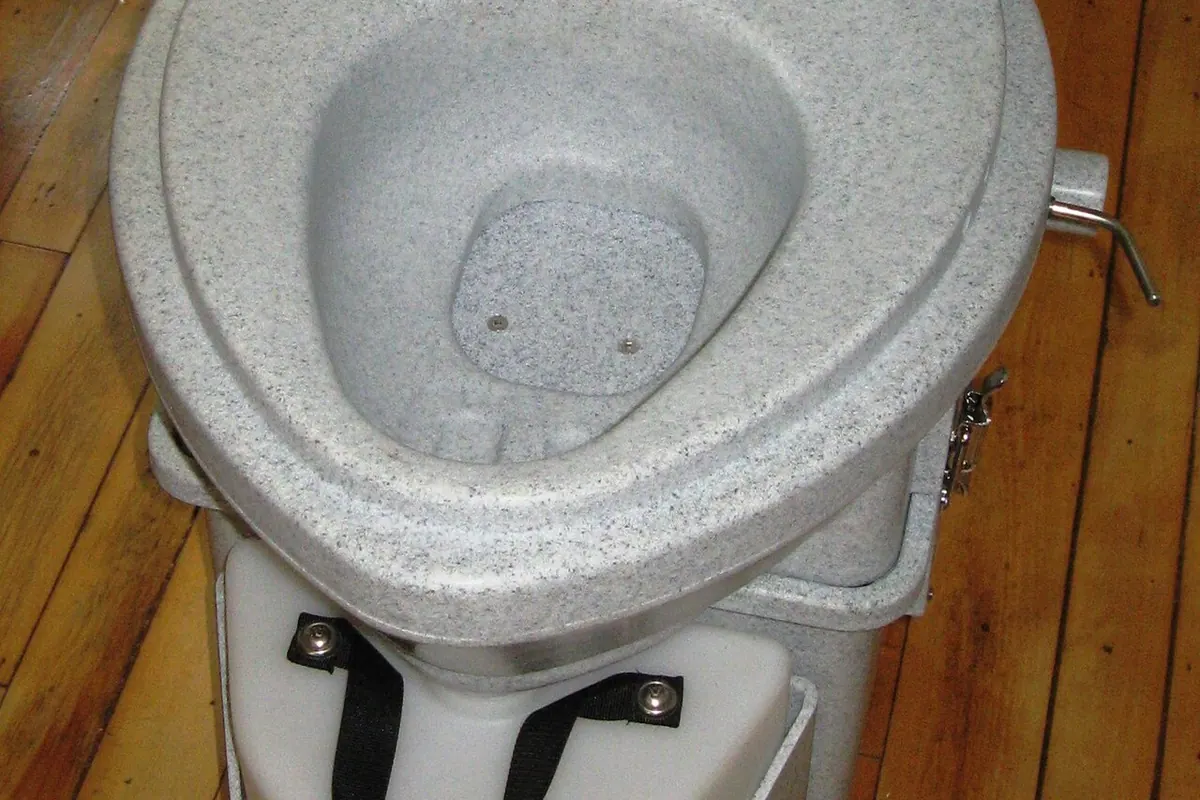
3. Fitted composting toilet for long trips
Nature's Head Composting Toilet
A self-contained, waterless urine-separating toilet with a 12 V fan, made in Ohio for RVs, boats, cabins and tiny homes. The solids bin takes about 60 to 80 uses between empties, says the maker.
- Waste capacity
- Urine 2.2 gal (8.3 l); solids about 60 to 80 uses
- Flush water
- None
- Flush
- None: agitator handle mixes the solids
- Size (H x W x D)
- 21 x 20 x 19 in (53 x 51 x 48 cm)
- Seat height
- About 20 in (51 cm), from the maker's drawing
- Weight
- 23 lb (10.4 kg)
- Power
- 12 V fan
Good
- No water and no chemicals
- About 60 to 80 uses between solids empties, says the maker
- Highest seat of the four
Bear in mind
- Needs 12 V and a vent to the outside
- The largest of the four, at 21 x 20 x 19 in
Check price on Amazon: Nature's Head Composting Toilet (affiliate link, opens in a new tab)Specs: Nature's Head: Composting Toilet
4. Portable composting toilet with no power
Trelino Evo S
A German separating toilet weighing 3.9 kg, with a 4.5-litre urine canister and a 6.5-litre solids container. It needs no water, chemicals or fan, so it suits a small van, a car or a tent.
- Waste capacity
- Urine 4.5 l (1.2 gal); solids 6.5 l (1.7 gal)
- Flush water
- None
- Flush
- None
- Size (H x W x D)
- 29.6 x 33.0 x 39.0 cm (11.7 x 13.0 x 15.4 in)
- Weight
- 3.9 kg (8.6 lb)
- Power
- None; no fan needed, says Trelino
Good
- Lightest of the four
- No water, chemicals, power or fitting
- Each container is emptied on its own
Bear in mind
- Small containers: about 9 to 11 urine uses and 6 to 8 solids uses, says Trelino
- Sits low, at 29.6 cm overall
Check price on Amazon: Trelino Evo S (affiliate link, opens in a new tab)Specs: Trelino: Evo S
Questions
Is a composting toilet better than a chemical toilet?
Neither is better for everyone. Thetford, which makes both, says a cassette toilet suits people who travel mainly between campsites and want something familiar, while a separation toilet suits long spells off-grid with less water and fewer additives.
Can I empty a chemical toilet into an ordinary toilet?
The Camping and Caravanning Club says to empty it at a chemical disposal point, often called an Elsan point. If there is none, the only alternative is an ordinary toilet, which may mean taking it home. Never use a grey water point or a drain.
Where do I empty a composting toilet?
Thetford says urine can be poured into any ordinary toilet and bagged solids can go in household waste where local rules allow. On a campsite, ask the staff, because some ask you to take bagged waste home.
Do composting toilets smell more than chemical toilets?
They control smell differently. Thetford says a cassette toilet relies on additives and regular emptying, while a separation toilet relies on good ventilation and optional consumables such as a drying agent.
Do composting toilets need electricity?
Fitted ones with a fan need power for it: the Nature's Head runs its fan on 12 V. Portable separating toilets such as the Trelino Evo S need no power at all.